Friday, July 22, 2011

Led-World Exclusive Comparison - LED TV vs LCD TV


When buying a TV, you might ask what is the best view, an LED or LCD TV. LED TV With the increasingly widespread, it is important to know what could be better to buy a TV LED.

When it comes to buying new TVs, the only time you should now have an LCD TV is that if you are buying a TV with a budget or can not find a TV LED on the size you need. Other TV shows are much cheaper LED TVs, but the price difference is down and soon find TVs LED to be so cheap.

Price aside, televisions LEDs have many advantages over LCD. They have a much better contrast ratio and black levels, better color accuracy, and power consumption. The only thing is to wait and see how long you can last TV LED compared to LCD TVs. This can not be determined yet because the LEDs are new televisions.

The contrast ratio of reason and black levels are much better on these sets because they use technology that can control and adjust the backlight. LCD TVs, the screen is to block the light turning the glass LCD. This ends up causing the television to have a contrast ratio of just less darkening.

When it comes to producing better color accuracy, LED backlit color TV dominates other TV. Color backlight allows the TV to produce very realistic colors. However, some TVs use white LED backlight, which is not much of an improvement in LCD televisions.

TV LEDs also have a better viewing angle. This is very important as you can watch TV in a wider angle. Most TVs have suffered a lot when it comes to viewing angles. Usually does not work so well when you go beyond 30 degrees off center. However, LED TV viewing angles are fantastic, and are almost as good as plasma TVs.

Energy consumption is very important because you can save money in the long term. TV LEDs have a slight improvement over LCD TVs when it comes to energy consumption, and near the power consumption of plasma TVs. However, this improvement in energy consumption is only true for edge-lit TVs, rather than local regulations LED TV.

When it comes to buying the TV, it is advisable to get a TV LED, since it seems to have many advantages over most LCD rivals. With advantages such as energy consumption, better viewing angles, contrast ratio and color accuracy, you can not go wrong with a TV LED

Thursday, July 14, 2011

2012 Peugeot 508 with its distinctive LED lights visible day and night


The Peugeot 508 RXH become one of the world’s most fuel-efficient vehicles off the road when it goes on sale in Europe in the second quarter of 2012. Peugeot Automobiles Australia spokesman Scott Williams said the local distributor was “actively considering” the 508 RXH to Australia, Australia and his colleague Richard Grant Peugeot repeated his enthusiasm. After the launch of the sedan and 508 SW in the spring of 2011, acclaimed for its elegant style, his presence and high quality construction and attention to detail, RXH 508 again raises the profile of all Peugeot strengthen its technological leadership.

His posture and his specific design immediately put it on the road worldwide. Unique, exquisite, high, increased, is also distinguished by a unique visual signature, with its distinctive LED lights visible day and night, giving an impression of ‘lions’ three vertical grip on each side of your grill ‘floating’ style What is even more impressive. To enhance its unique character, the benefits within 508 RXH special features with different colors and luxurious materials such as premium quality interior and upholstery. Aspects covered will also be equipped with a luxurious range of technologies for the Peugeot 508 RXH. this model will be equipped with Keyless Go system & Open, electric front seats, head-up display, 18 “wheels, panoramic glass roof black, black acoustic laminated side windows and cutting-edge audio and satellite navigation units.

Outside Peugeot 508 2012 RXH go with three vertical stripes on the girl LED on each side to make it more like the futuristic car. In the foot, this car will be equipped with 18 “wheels, and another feature will be added, such as panoramic sunroof and Head Up Display. RXH The 508 can operate in electric-only mode, while Peugeot has not revealed the vehicle ‘s “zero-emissions ” range. The French carmaker said RXH 508 consumes less than 4.2 liters of diesel per 100 km (56 mpg U.S.) in combined cycle and emits 109 g / km of CO2. Peugeot 508, 2012 RXH diesel-electric hybrid can operate in electric mode only then, however, the Peugeot did not reveal the driving range yet.

Peugot 508 RXH says consumes less than 4.2 liters of diesel per 100 km on the combined cycle, which is the equivalent of 56 miles per gallon U.S. Equipped with the 2.0 l HDi FAP HYbrid4 drive train, the world’s first full diesel -electric hybrid engine, the 508 extends RXH driving pleasure and freedom to travel anywhere on all roads. With a maximum power of 147 kW (200 hp), four-wheel drive and a maximum torque of 450 Nm, 508 RXH designed to meet all uses in a variety of conditions. It also opens new perspectives in the segment, offering a 100% electric ZEV mode, ideal for city driving and to reduce consumption in the combined cycle of 4.2 l/100 km with CO2 emissions of 109 * g / km.

LED Lighting: Public Transportation Vehicles Market Forecast (2010-2017)

Mass-Transit Vehicles. According to the ElectroniCast report, the global consumption quantity (unit rc helicopter and car market place volume) of LED-based lamps/devices in public transportation vehicles reached 17.0 million units worldwide in 2010 (a 22% increase over 2009).

For the purposes of this study, ElectroniCast defines public transportation (public-transit / mass-transit) as a shared passenger transportation service, which is available for use by the general public. Public transportation vehicles, included in this study, are listed below. Note: aircraft and taxis are not included in this analysis. The LED lighting public transportation vehicles global market is segmented into the following vehicle (type) categories:

• Bus • Rail and Rapid Transit Vehicles o Light-Rail, Tram/Trolley/Streetcar o Rapid Transit/Metro and Subway/Underground o High-Speed, Commuter/Intercity and Long-Distance • Ferries/Watercraft

The market forecast is also segmented into the following product-type:

• LED Linear Lamps (Tubes) • LED-based Back Light Unit (BLU) Bars for LCD Display Screens • LED Signage/Destination Sign Board Modules • Other/Miscellaneous LED Lamps and Luminaries

� aston martin �Market analysis and technology forecasting are complex tasks. Any predictions of the shape and trends of technology and economic movement start from the notion that the germ of what will be important tomorrow is present, although smaller or larger or in a different form, in our environment today. However, taking as a basis for a prediction the assumptions of current, conventional belief creates a set of preconceived notions that can lead to serious mistakes. ElectroniCast, instead, looks to the basic driving forces," said Jeff D. Montgomery, chairman and founder of ElectroniCast Consultants.

� auto part �ElectroniCast then considers customer expectations of near term growth in their application, plus forecasted economic payback of investment, technology trends and changes in government regulations and funding/tax-break legislation/rules in each geographical region, to derive estimated growth rates of quantity and price of each product subset in each application. These forecasted growth rates are combined with the estimated baseline data to obtain the long-range forecasts at the lowest detailed level of each product and application. In this ElectroniCast report, we have covered these issues, by providing information on technology, product supplies, overviews of modes of public transportation, economic and government actions, and so on," Montgomery added.

According to Electronicast, in 2010 the quantity (volume) of LED-based lamps/devices used in public transportation vehicles reached 17.0 million units. During the 2010-2017 timeline, ElectroniCast forecasts the quantity consumption will grow at an average annual rate of 28.5 percent, reaching 92.2 million units in 2017 (see Figure). The market forecast data in the ElectroniCast report refers to consumption for a particular calendar year; therefore, this data is not cumulative data.

The Asia Pacific region (APAC) American region is forecast to maintain the lead in relative market share throughout the forecast period; however growing at a slightly slower pace than the EMEA region. In general, the EMEA region (Europe, Middle East and Africa countries) has been a bit slower to embrace some of the LED lighting solutions versus other regions; however, the trend is changing and the EMEA consumption is set to increase at a steady pace.

The America region, especially the United States, loves the automobile with one occupant per car during the commuting process. However, pushed by many ecological concerns, economical pressures and other factors, the c ferrari all for public transportation is considered an option for some commuters. The America region has a relatively high LED product take-rate per vehicle, especially in the United States and Canada. The America region is forecast to maintain strong growth, especially with the assistance of the U.S. Department of Energy green-tech stimulus funding and other programs that are supportive of LED-based lighting solutions. Also, Latin America, with an emerging modernization of public transit in the bus category, will provide new opportunities for LED producers throughout the forecast period.

This 559-page market forecast report is available immediately from ElectroniCast Consultants. For detailed information on this or other services provided by ElectroniCast, please contact Theresa Hosking, Marketing/Sales; thosking@electronicastconsultants.com (Telephone/USA: 707/275-9397)

ElectroniCast Consultants – www.electronicast.com specializes in forecasting trends in technology forecasting, markets and applications forecasting, strategic planning and consulting. ElectroniCast Consultants, as a technology-based independent forecasting firm, serves industrial companies, trade associations, government agencies, communications and manufacturing companies, as well as the investment/financial community. Reduction of the risk of major investment decisions is the main benefit provided. ElectroniCast Consultants' goal is to understand the challenges and opportunities facing clients and to provide timely, accurate information for strategic planning.

According to ElectroniCast, the annual global consumption quantity (unit volume) of LED-based lamps/devices in public transportation vehicles is forecast to increase from 17 million units last year in 2010 to 98.2 million units in the year 2017.

LED Lamps/Devices Used in Public Transportation Vehicles Global Consumption Quantity/Volume Market Forecast (Source: ElectroniCast Consultants)

Friday, May 20, 2011

Led-World Exclusive - All-LED-lights Mercedes-Benz CL on 2011 Shanghai Auto Show


"Innovation for Tomorrow" is the slogan of the fourteenth session of the Shanghai auto show. Based on this concept, the auto show brings many new technologies to the first facing the public. Mercedes-Benz CLS enjoys its debut on the auto show. Its 71 LED lights design makes it the focus. 2011 Shanghai Auto Show

LED has been used in automotive lighting for some time, but now there are only two kinds of vehicles applying the all-LED headlights: Mercedes-Benz CLS and Audi A8. According to manufacturers, those Audi A8 sales domestically use Xenon headlights and all LED lights are only options. Then here are the questions: What about all LED headlights? Will them become the future mainstream?

Currently, a single LED light source intensity is still less than xenon lamps. Among the majority of the car lights, LED lamp only plays a supporting role for Xenon Headlights. To reach the same brightness, even high-brightness LED requires an additional group LED lights comparing with the xenon lamps. And this group of high-brightness LED costs much and release much more heat than xenon lights.

However, the manufacturers tell us that, through some special power conversion device, LED light can issue different color temperature. The car headlights of Mercedes-Benz CLS can transform the color temperature under certain conditions and can be used as fog lights. Audi A8's daytime running lights can be converted into turn signals.

At present, LED lights have been widely used as auxiliary lights for vehicles. In turn lights, fog lights, and many other places LED Lights have replaced other sources. However, the high cost of LED brightness and thermal are the problems that R & D personnel facing. LED lighting as the main front Car Headlights is still immature. If this bottleneck breaks, LED will be the future of the automotive field.

Now, if you want to replace your car headlights, HID Xenon Car Headlight Kits are still your best option. They are providing driver better visibility and nigh vision for safety concern. NearbyExpress.com is a professional wholesaler and dropship supplier of Car Eletronics. The products are now at low China wholesale price for all its clients.

Philips introduces 75W equivalent LED light

Philips claims that the new lamp will create light that will be indistinguishable from a standard incandescent light bulb.

LED lamps are expected to revolutionize the lighting industry because of their sharply reduced power consumption and their long life compared with standard incandescents. But to date, market acceptance has been slow given the high initial cost and limited brightness. LED lamps have only been able to emit light equivalent to a 60-watt standard bulb.

On Friday, Philips will look to change that game by announcing that it will market an LED lamp later this year whose light output equals that of a 75-watt incandescent.
The bulb, the EnduraLED A21, will retail for about $40, last 25,000 hours and produce 1100 lumens of light by consuming just 17 watts of electricity. (A standard 75-watt lampfrom GE produces 1170 lumens.)
Over the life of the lamp, Massachusetts consumers will save $300 in electricity costs alone and will break even in 1.6 years.
"The trick with an A lamp is how to project 1100 lumens in 360 degrees," said Ed Crawford, general manager of lamps for Philips Lighting, North America. "It's absolutely more difficult to do 1100 lumens in an omni-directional lamp."
To accomplish that, the new lamp, available around September or October, contains 18 LED modules fixed in multiple directions. Various metal fins surrounding the lamp are used to dissipate heat.

Monday, April 4, 2011

Salute to Father of LED


Nick Holonyak
Zeigler, Illinois; 1928

NICK HOLONYAK, JR. was born in Zeigler, Illinois on November 3, 1928. he attended the University of Illinois and received a B.S. (1950), M.S. (1951), and Ph.D. (1954) in Electrical Engineering. A Texas Instruments Fellow, he was John Bardeen’s first student. He later was employed as a member of technical staff at Bell Telephone Laboratories (1954-55) and helped demonstrate feasibility of diffused-impurity silicon devices, including transistors, oxide-masked transistors, p-n-p-n switches and SCR’S. He served with the U.S. Army Signal Corps (1955-57) at Ft. Monmouth, New Jersey, and at Isogo-ku, Yokohama, Japan. In 1957 he joined the Advanced Semiconductor Laboratory of the General Electric Company (Syracuse) and made contributions in the areas of power and signal p-n-p-n devices (including invention of the shorted-emitter and symmetrical SCR and thyristor switches—TRIAC’s, etc.), tunnel diodes, phonon-assisted tunneling (the initial observation of inelastic tunneling and the beginning of tunneling spectroscopy), halide transport and first epitaxial growth of III-V compounds and compound mixtures (including heterojunctions, 1960-63), double injection and deep-impurity-level effects, junction luminescence (GaAsP LED’s), and III-V alloy semiconductor lasers (visible spectrum, GaAsP, 1962). His work from 1960 to 1962 on GaAsP and the initial construction in 1960 of a p-n junction in the crystal system, and a visible-spectrum (red) laser in 1962, led to the commercial introduction of red GaAsP LED’s (and eventually to the concept of an “ultimate lamp”). He is the inventor of the first practical light emitting diode (the GaAsP LED), which also marks the beginning in the use of III-V alloys in semiconductor devices (including heterojunctions.)

Since 1963 he has been a professor at the University of Illinois in the Department of Electrical and Computer Engineering and is a member of the University of Illinois Center for Advanced Study. He and his students have worked primarily on III-V semiconductors, III-V alloy crystal growth and the demonstration of red-orange-yellow-green stimulated emission in In1-xGaxP, In1-xGaxP1-zAsz and A1xGa1-xAs1-yPy, stimulated emission on nitrogen trap transitions in the alloys GaAs1-xPx and In1-xGaxP, and heterojunctions in various ternary III-V’s and in the quaternaries A1xGa1-xAs1-yPy and In1-xGaxP1-zAsz. He and his students were the first to make quaternary III-V semiconductor devices (LEDs and lasers.) Since 1976 he has been concerned with quantum-well (QW) light emitters and lasers, and with impurity-induced layer disordering, which shifts lower gap quantum well layers to higher gap bulk crystal and serves as a basis for integrated optoelectronic devices. In 1990 he and his students introduced (~400˚C) stable native oxides on, and buried in, Al-bearing III-V compounds and demonstrated their use in optoelectronic devices (LEDs and lasers). He and his students were the first (1977) to construct p-n diode quantum well lasers (InP-InGaAsp, LPE) and were the first to achieve (1978) continuous (cw) room temperature (300 K) laser operation of quantum well heterostructures and superlattices, and later (1982) strained layer quantum well heterostructures. They are the source of the name “quantum well laser.” Most recently (with Dupuis, 2001) he introduced tunneling-coupled quantum-well-assisted quantum-dot lasers, and (with Feng, 2004) the light-emitting three-port operation of heterojunction bipolar transistors, including QW-based HBTs and, after 57 years, a transistor laser.

He is co-author of the book SEMICONDUCTOR CONTROLLED RECTIFIERS (Prentice-Hall, Inc., 1964) and PHYSICAL PROPERTIES OF SEMICONDUCTORS (Prentice-Hall, 1989), editor of the Prentice-Hall series “Solid State Physical Electronics,” and has served on the Editorial Board of the PROCEEDINGS OF THE IEEE (1966-1974), SOLID-STATE ELECTRONICS (1970-1991), and JOURNAL OF APPLIED PHYSICS and APPLIED PHYSICS LETTERS (1978-1980). He received a General Electric Cordiner Award (1962), and for his contributions to the field of visible-spectrum light emitting diodes and diode lasers, he is the recipient of the IEEE Morris N. Liebmann Award (1973), the John Scott Medal (1975, City of Philadelphia), the first GaAs Symposium Award with Welker Medal (1976), the IEEE Jack A. Morton Award (1981), the Electrochemical Society Solid State Science and Technology Award (1983), the Sigma Xi Monie A. Ferst Award (1988), the IEEE Edison Medal (1989), the Charles Hard Townes Award of the Optical Society of America (1992), the National Academy of Sciences Award for the Industrial Application of Science (1993), American Electronics Association 50th Anniversary Award (1993, “Inventing America’s Future”), American Society for Engineering Education Centennial Medallion (1993), Vladimir Karapetoff Eminent Members’ Award of Eta Kappa Nu (1994), TMS John Bardeen Award (1995, The Minerals, Metals, and Materials Society), 2000 IEEE Third Millennium Medal, Frederic Ives Medal of the Optical Society of America (2001), the IEEE Medal of Honor (2003), the Washington Award (Western Society Engineers, 2004), the Lemelson-MIT Prize (2004), and the MRS Von Hippel Award (2004). In 1990 he received the U.S. National Medal of Science and in 2003 the 2002 U.S. National Medal of Technology. In 1992 he received from Northwestern University an honorary doctor of science degree and was elected an honorary member of the Ioffe Physical-Technical Institute (St. Petersburg, Russia). In 1994 he received an honorary doctor of engineering degree from Notre Dame University, in 1995 the Japan Prize, and in 2003 the Global Energy International Prize (Russia). In 1993 he was appointed (University of Illinois) the John Bardeen Chair Professor of Electrical and Computer Engineering and of Physics, a chair sponsored by the Sony Corporation. He is a member of the National Academy of Engineering (1973), a member of the National Academy of Sciences (1984), foreign member of the Russian Academy of Sciences (1999), eminent member of Eta Kappa Nu (1998), fellow of the American Academy of Arts and Sciences (1984), fellow of the IEEE (life fellow, 1994), fellow of the American Physical Society, fellow of the Optical Society of America, fellow of the American Association for the Advancement of Science (2003), and laureate of the Lincoln Academy of Illinois (2005). In 2008 he was inducted into the U.S. National Inventors Hall of Fame.


Semiconductors, quantum well and dot lasers, LEDs, transistor lasers, optoelectronics

Professor Holonyak has made fundamental contributions to the science and technology of elemental and compound semiconductors, including major achievements in solid-state lasers and incoherent light emitters. He invented the first practical light-emitting diode and is the first to make III-V alloy devices (III-V alloys now part of all high performance lasers and LEDs, U.S. Patent #3,249,473). He and his students built the first p-n diode quantum well lasers and introduced the name quantum well lasers (also vital now in all lasers and LEDs). He is known also for his work on early diffused silicon devices, tunnel diodes, and silicon-controlled rectifiers, including invention of the symmetrical switch. (TRIAC) used in wall light dimmers. He was the first to observe inelastic tunneling, which is the beginning of tunneling spectroscopy. Among the 39 patents he holds on semiconductor materials and devices are the fundamental patents on quantum-well layer disordering and on the aluminum-based III-V oxide, now being exploited in optoelectronics (and a licensed U of I technology).

For his contributions to the field of semiconductor materials and devices, visible light-emitting diodes, diode lasers, and quantum-well heterostructure lasers, he received the IEEE’s Morris N. Liebmann Award, Jack A. Morton Award, Edison Medal, and Third Millennium Medal; John Scott Medal of the City of Philadelphia; Solid State Science and Technology Award of the Electrochemical Society; GaAs Symposium Award with Welker Medal; Monie A. Ferst Award of Sigma Xi; Charles H. Townes Award and Frederick Ives Medal (2001) of the Optical Society of America; National Academy of Sciences Award for the Industrial Application of Science; American Electronics Association 50th Anniversary Award; American Society for Engineering Education Centennial Medallion; Vladimir Karapetoff Eminent Member’s Award of Eta Kappa Nu; and John Bardeen Award of the Minerals, Metals and Materials Society.

He received the 1990 National Medal of Science, an honorary doctorate of science from Northwester University (1992), and an honorary doctor of engineering degree from Notre Dame University (1994). He is an honorary member of the Ioffe Physical Technical Institute (St. Petersburg, Russia). In 1995 he received the Japan Prize. In 1997 the Optical Society of America established the Nick Holonyak, Jr. Award; in 1998 he was elected an Eminent member of Eta Kappa Nu; and in 1999 he was elected a foreign member of the Russian Academy of Sciences. He is a member of the National Academy of Engineering, the National Academy of Sciences, and the American Academy of Arts and Sciences. Eight former graduate students are elected members of the National Academy of Engineering. In 2003 he received the Medal of Honor of the Institute of Electrical and Electronic Engineers (IEEE); Global Energy International Prize, Russia; U.S. Medal of Technology; and was elected a fellow of the American Association for the Advancement of Science. In 2004 he received the Washington Award, of the Western Society of Engineers, the Lemelson-MIT Prize of invention, the MRS Von Hipple Award; and in 2005 was named a Laureate of the Lincoln Academy of Illinois. In 2006 he became a Member of the Consumer Electronics Assn Hall of Fame, and in 2008 was inducted into the U.S. National Inventors Hall of Fame.

His research now is concerned with coupled quantum-dot/quantum-well lasers, light-emitting transistors (LETs), and transistor lasers (LTs), which has resulted in fundamental changes in transistors and in lasers.

Thursday, March 10, 2011

Led-World Exclusive - Top 6 Most Expensive MotorBikes in World

Motorcycles have been one of the most favorite and commonly used modes of transport for the general public for around 150 years now. It was in the 1860s that the first motorcycle was designed by Sylvester Howard Roper who was an American.

Since then the two-wheeler has seen tremendous changes. They are trendier, sleeker, fastest and most expensive. Here, we present you with a list of world’s most expensive bikes. Just have a look – “Starting from most expensive on the planet”

Dodge Tomahawk V10 Superbike

Cost – $555,000 (24969405 INR)

This is probably the only two-wheeler which has four wheels. The bike is regarded as an ‘automotive sculpture’ but yet street illegal in the United States. A superbike in the real sense, the bike has 8.3 liter engine, which is equivalent to 505 cubic inch. The bike is equipped with as many as 10 cylinders. It takes just around 2.5 seconds to reach the 60 mph mark and can be driven at a maximum speed of 400 mph.

Ecosse Titanium Series RR Limited Edition


Cost - $275,000 (12372228 INR)

This limited edition bike is limited in the real sense. Only 10 units of the bike are manufactured. As the name suggests – limited edition, is a powerhouse when it comes to the capacity of the engine and the speed it generates. Sheer imagination is enough when you know that the bike has a 2150 cc engine with more than 200 hp. The bike has a watch, manufactured by French watchmakers BRM, which is made exclusively for this bike only.

Macchia Nera Concept Bike

Cost – $201,000 (9042974 INR)


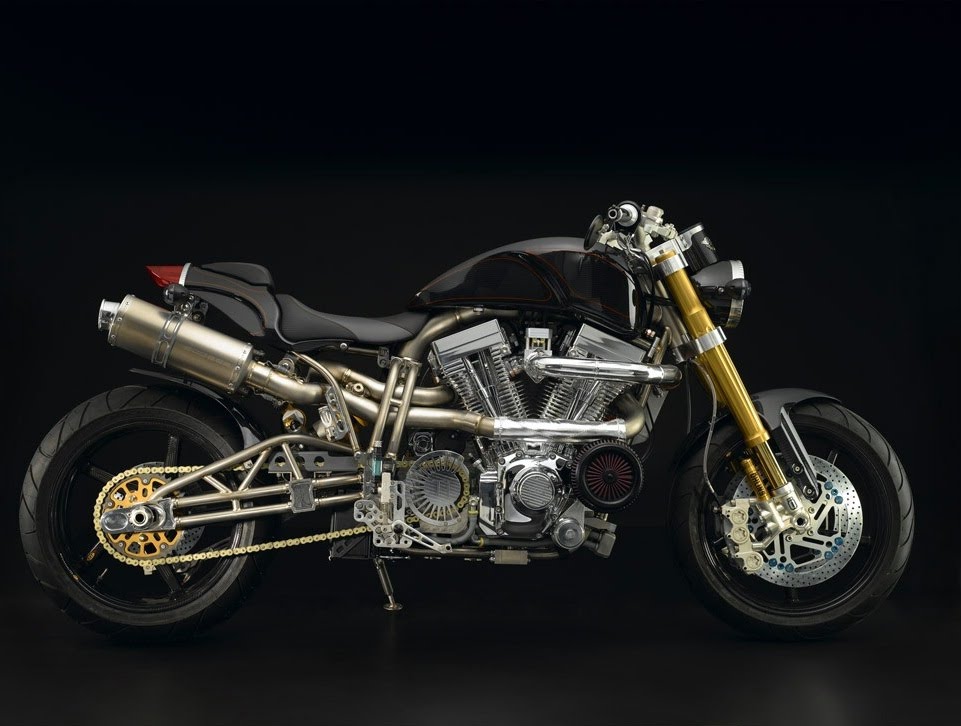
The Macchia Nera concept bike happens to be one of the best bikes in this segment. The bike sports an engine that is loosely built around the Ducati 998RS engine. A side view of the bike will show you the structure of the bike. The engine is visible along with the detailed molding and the engine components.

However, the unique thing about the bike is that in spite of such a heavy built, it is extremely light – as far as the category in which it is built is concerned.

Icon Sheene


Cost – $160,000 (7198387 INR)


Icon Sheene was produced exclusively in the memory of Andrew Morris, who was one of the most successful British Grand Prix motorcycle champion. When he passed away, he was 52 years old. That is why only 52 of such bikes were produced. The bike has a 250 hp engine and has a whopping 1400 cc engine – nothing more than a flying experience.

The thing worth mentioning about this bike is that, in spite of being such a heavy bike, the Icon Sheene has only a couple of spokes in the wheels. Sounds strange and happening, but that is the fact.

MTT Turbine Super Bike

Cost – $150,000 (6748488 INR)


The second last bike in the series is the MTT Turbine Super Bike. MTT Turbine Super Bike aka Y2K Turbine Super Bike is not in the list for nothing. This bike is a combination of both most expensive and super fast bike. The bike also holds the Guinness World Record for being the most powerful motorcycle which has entered a series of production.

The engine has a power of more than 300 horse power. The unique thing about this bike is that it is loaded with various gadgets. It has a camera mounted on the rear, it has a LCD color display, it has a radar detector, a one touch ‘Smart Start’ among others gadgets.

MV-Augusta F4CC

Cost – $120,000 (5398790 INR)


The MV-Augusta F4CC was designed and created by Claudio Castiglioni, who was MV’s director. Certainly, this bike took birth through passion for having a bike that would not only be eye-catching but would also serve the purpose of the consumers of owning something different and unique.

The MV-Augusta F4CC can be driven at a maximum speed of 315 kmph which is around 195 mph. This tremendous speed can be achieved curtsey the 1078 cc powerful engine. It is also featured with 198 hp power generation. The model number of each bike is shown near the steering column.

Wednesday, March 9, 2011

Led-World Exclusive - Audi A6 will soon flaunt all LED headlamps

Nowadays one can see many cars fitted with those LED lights, but do any of you know who the pioneer of those cute yet smart headlamps was? So for your information, it was Audi, who basically started these LED headlamps with the launch of its all new (at that time) Audi R8. Anyways, now it seems that Audi is trying to get it even better with the Audi A6. Audi is trying to improvise on the same for its much praised Audi A6. Till now, car manufacturers use both LED with Xenon headlamps. So, it will be the first time when a sedan especially will flaunt an all LED headlamp cluster. Later on even the Audi A8 and Audi A7 will also join the club. Besides this, all LED headlamps, this car will still be offered with Bi-Xenon and Halogen headlamps also.

There are numerous reasons to choose a full LED headlamp over the normal Bi-Xenon or Halogen headlamps. Say for example these ultra powerful LEDs produce a strong white beam exactly like a day light but only consume not more than 4watts of energy. Because of the four one chip, five two chips LEDs the energy consumption is really low. These new headlights in the Audi A6 will also have an added feature which is high beam assistant and special adaptive light control. Wondering what’s that? It is one of the features that will make you drool for it for sure. These headlamps are directly connected to a camera facing forward which will continuously send signals to the headlamps about any change recorded in the ambient light. I guess you know what this headlamp will do. Yes, it will perform accordingly. So, it seems that Audi is really making head turns with its new inventions.

Future development trend of LED in car light


After the developing stage that LED car head-light is shown in technology proving, concept car that is gone through in recent years,etc., welcomed the expected prospect of entering the market of producing car of applying to amount at last, there are three its significant incident: Will Ling of Toyota LS600h in the world first to adopt, shine the listing bus of the light source in front of the LED, but it has employed LED only on the low beam light, the long-range light source is still a halogenic light. The Audi R8 regards the whole LED head-light as its main characteristic, LED adopted in and the car illumination is offering by Lumileds and Osram Company. Cadillac EscaladePlatinum platinum edition multi-functional sport car, it is first multi-functional sport cars which adopt LED head-light.

Hinder LED light source from opening up the unfavourable factor of the automobile-used market rapidly

Does the above-mentioned milestone incident mean LED head-light will set up horses and become innovative technology which will decide the automobile-used light source field? According to the estimation by experts: Perhaps can not. The cost that it is LED can drop continuously according to the prediction speed of one Mole of laws, it is low to can reach with HID for it to want ‘ The high strength discharges The equal price that the xenon lamp is equal to has been still needed for many years too; And it can be comparable to halogenic light if the cost of LED family should be dropped to, need to pass a period of longer time course.

Draw according to Hella sea Fischer, president of company, claim automobile-used scale of LED account for their light source the intersection of market and a few percent little share only at present, so to the type in enormous quantities correctly ‘ Style such as GM / Chevrolet Malibu fund of one Complete network supply utmost point interested in. But LED wants to reach to the stock level of Malibu style so in enormous quantities, still needs to overcome a series of technology and cost difficult problem, have course in ten years that will go at least.

Big the open paces that point out, LED enters the market are really a little slower than the ones that originally expected generation, we had predicted in 2004: LED the intersection of car and lantern fair blowout enters the market, and eliminate HID soon. Obviously, present situation to so, can expect the intersection of LED and technology fast a bit than reality gradual progress. It seems it is not the only factor of hindering LED from appearing on the market that the cost is high, still a challenge difficult problem of technical feature needs solving.

For example, in terms of single light source, the illumination intensity of LED still shows insufficiently. And can not reach followingly and satisfactorily and calculate only: It contributes to narrowing taking up the space and easy to be flexible to fix up of the car lamps and lanterns to cut down and form number of LED light source which makes the lamps and lanterns up, and can simplify and light systematic wiring and install and reduce the production cost.

The major state that LED supplies the chain is at present: It is bright Osram to draw LED light source component which supplies the common Cadillac Escalade style in the sea to the department of Europe Purchase; And small Zhyuan’s car light Koito LED last light source of the Companies products, be lasted LS600h style in Toyota and then; The intersection of Philip and Lumileds give AL the intersection of LED and the intersection of light source and supply ‘ The car lights The company, is and then disposed the car light system for the Audi R8 by the latter.

According to American-European manager of business department of Koito, they will not limit the kind of the light source and purchase the manufacturer for being firm and oneself rowing, no matter at whom does it produce in ‘ Philip, Ou department are bright, or Toyota Gosei Can all buy. Obviously, the flexibility that the first class suppliers who light the systematic part attempt to keep oneself purchasing the light source components and parts, want to observe it: Which device products technology of the manufacturer can progress fastest, the cost performance is highest.

LED criticize for the photoelectricity of the goods to change nowadays ‘ The light energy density The index reaches 80 lumen per watt ‘ 80lm/W The above, but HID light is 90lm/W, the halogenic light is 201m/W. According to another draw in the sea and notify: The latest LED researches and develops this index already up to 161lm/W of the prototype. Draw in the sea and also predict: During 3-5 years in the future, LED luminous intensity of releasing from the same consumption chip will be promoted by 50%. This not only means LED lamps and lanterns will be more bright but also reflect the cutting down of its energy consumption, thus improve the fuel economy of the completed car.

It is estimated, mileage that the ones that replace mpg per gallon of fuel that the halogenic lamps and lanterns can promote the completed car with LED go About 0.25 indexes. And when going to Europe to turn on the regulation of going of the light in the daytime, expand promoting value of this mpg to 0.5. Ling Zhi’s style manager points out, there will be very great contribution to employ LED lamps and lanterns economic improvement to fuel of completed car.

But strong the intersection of density and high LED want, give out more heat too only, and compactness of lamps and lanterns fix up, make the area suitable for dispelling the heat trend towards lightly again. It is much fewer than halogenic light or HID lamps and lanterns that the ones that belong to low energy consumption LED device of the semi-conductive classification truly generate heat, but the majority of the latter’s heat is turned into not including the lamps and lanterns device, and LED although low power dissipation grow hot to want, seal, come on, conduct inside small silicon chip heat while being little.

The hot management of LED is a great difficult problem

Even smaller heat will concentrate to go up to the chip size device conducted and dispersed, because the heat capacity of the device is small will cause the rising suddenly of LED temperature. The working temperature of LED must keep in 150 ranges of under ℃. A kind of solution to this heat-dissipating problem is: Use the intersection of number and more LED give out light component in one lamps and lanterns, let the single caloric value of one be relatively little, it makes it apt to dispel the heat to and then fix up them in the larger space. Tactics adopted at being small the intersection of Zhyuan and car light for will LS600h related head-light Ling of Toyota this.

Cadillac EscaladePlatinum each head-light is formed by 7 LED fluorescent lamps, 5 among them are used in light beam of short range, another 2 are regarded as the long-range light source. They all have their own active heat-dissipating devices –Cool the fan ‘ Similar to disposing the small fan in the desk-top computer .

Draw and claim, it is a design field especially bothered about and troubled by them that heat is managed according to the sea, lay particular emphasis on relying on the fictitious artificial means to assess optimizing in the scheme is chosen, and is imitating tools ‘ Artificial software package If you can’t select to use, pass by textual criticism of experimental datas enough. Point out he,for heat last heat-conduction challenge of problem of management not merely,can with the aid of ” The hot pool ” The device gets the heat that LED component produces out, and will solve and ventilate the problem, let heat distribute out of lamps and lanterns device. If it is not obviously enough to only depend on natural ventilation, so draw the decision and add the built-in fan for the lamps and lanterns in the sea

Monday, February 28, 2011

Comparison - Led-vs-Fluorescent-vs-Incandescent


If there’s one constant in this world, it might just be that technology is always changing. The second you feel as if you may finally have a handle on it all, it changes so much that you have to just about start at square one. The same goes for lighting. Lamp technology has changed so much in recent years that knowing which ones to include in a kit has become as difficult as solving world hunger. That’s why we’re going to look at some of the newest and best light fixtures for incandescent, fluorescent, and LED and give you some tips on which lights work best for every type of video production. Though we can never show you the exact lighting kit to buy for your needs, hopefully we can point you in the right direction.

Incandescent


Unfortunately, there is precious little to say that would make incandescent bulbs look good. They produce a lot of heat and guzzle power like a Hummer guzzles gas. These features don’t bode well for the incandescent’s future, but there is one redeeming quality: incandescent bulbs are still the brightest lamps money can buy. They are also some of the cheapest fixtures on the market today. If you need something that can compete with the strength of the sun or light the inside of an entire house, then incandescents and HMI’s are really the only way to make it happen.

Though I do my best to be good to the environment, I have to admit that I still use incandescent PARs like Smith Victor’s A80 or Lowel’s Omni and DP as the backlight in my three-point lighting setups. I just find it too hard to get the rim light strong enough while still keeping the fixture out of the shot using any other type of lighting fixture. Also, for background washes, I still use a Lowel Tota light with a 750W bulb or a Cool-Lux Hollywood Soft Light with a 1000W bulb. These fixtures combined with gels and cookies give me the light intensity and look I need for backgrounds in larger scenes. Lighting the same scene with fluorescents or LED lamps would require several fixtures, making it more difficult to get wide shots without stands in the frame and of course, making it more expensive too.

The other advantage of using incandescent-style bulbs is that I can dim the lights without ballasts by using a heavy-duty light dimmer available from any home improvement center. This makes light dimming affordable, but does change the color temperature of the light when dimmed. However, I am usually able to live with the results.

The most affordable incandescent lights on the market right now come from Lowel, Smith Victor, and Cool-Lux which sell great interview lighting kits for a good price. If you’re looking for lights that industry professionals use most often, both ARRI and Mole-Richardson offer some high-quality lighting kits as well. Depending on what you’ll be using these lights for, there should be a light amongst these manufacturers that fits your needs.

Fluorescent


On the other hand, fluorescent bulbs produce very little heat and draw less than a quarter of the power of similar incandescent lights. They are generally very soft lights and tend to look great as key lights for interviewing subjects. The biggest problem with this lamp type is that they can’t be dimmed by a simple variable resistor dimmer. Since fluorescents work by using bursts of electricity to fluoresce gas inside of a tube, cutting down on the amount of electricity to the fixture will either make the light blink or turn off altogether. This means that the only way to dim fluorescent lights is to use a ballast which makes the fixtures fairly large and cumbersome. That’s why these kinds of lights are typically used in studios rather than field work. We actually use fluorescent lights from Kino-Flo such as their 4-Bank and DivaLites to light our green screen and subject in our studio. That being said, companies like Kino-Flo have been hard at work putting together systems, like their Barfly, that are easier to use in the field. These kits usually have fluorescent lamps with ballasts built right into the unit along with hard cases to withstand the frequent abuse of using lights on the road. In fact, many major networks are now using fluorescent fixtures for their studios since it saves so much on cost and generally casts a pleasing soft light on their anchors.

Some of the best fluorescent light fixtures can be found at Kino-Flo and FloLight, who have been in the industry for a while. You can also check out Videomaker’s review on the Kino-Flo Barfly to see for yourself what these fixtures can do.

LED

Of all of the lighting technologies, the most promising is the LED. LEDs are an answer to many of the problems gaffers had with incandescent light fixtures. LEDs are small, lightweight, produce almost no heat, draw very little power, can be dimmed without changing color temperature, and can even go between color temperatures at the flick of a switch. With all of these features, it’s no wonder that LED fixtures seem to be the Holy Grail of video lighting.

The only real problem with LEDs are their limited light intensity. Even the strongest LED lamps fall woefully short of the amount of lumens an incandescent lamp can throw on a subject. That’s why LEDs are most often used as key and fill lights in interviews, and on-camera lights since the fixtures can be placed close to the subject in these situations. With the way technology advances in the world of LEDs, I can only imagine that it’s just a matter of time before these lamps begin to equal those of incandescents. In fact, some companies such as LitePanels with their Sola, and ARRI’s L-Series Fresnel concept are now making LED fixtures that are just as bright as similar incandescent fixtures.

Even so, LED light fixtures are hard to beat for field shooting. They are lightweight, can take a decent amount of abuse, and can run off of battery power for long periods of time due to their low power consumption. Lights like these have become very popular at trade shows and events where lighting is usually less than ideal and space is limited. This last year at CES, I saw dozens of people using LED fixtures like the LitePanel 1×1 with an external battery pack for quick interviews and product shots. Many energy conscious studios and buildings are using them too. The White House Press Briefing Room saw their energy consumption drop 95% after using LED fixtures. Even prime time television shows such as Fox’s 24 used LEDs to light parts of their set.

Though only a handful of companies once sold LEDs, most brand name manufacturers have jumped on the LED bandwagon. Kino-Flo’s website has a coming soon page for LED lighting kits, ARRI now sells LoCaster LED fixtures as well as hybrid LED kits, FloLight sells Microbeam LEDs in both a small and large form, Mole-Richardson has a MoleLED concept light that is soon to be released, and Lowel introduced their Blender which can switch between indoor and outdoor color temperatures. Videomaker has also had the privelege to review some of the more interesting LED lights over the past couple of years including the ARRI H-2 “Hybrid” kit, and the LitePanel 1×1 Bi-Color light, both of which are dimmable and can switch color temperatures. Though many of these lights can be more expensive than their incandescent counterparts, the flexibility and energy savings they give is almost always worth the cost.