Philips claims that the new lamp will create light that will be indistinguishable from a standard incandescent light bulb.
LED lamps are expected to revolutionize the lighting industry because of their sharply reduced power consumption and their long life compared with standard incandescents. But to date, market acceptance has been slow given the high initial cost and limited brightness. LED lamps have only been able to emit light equivalent to a 60-watt standard bulb.
On Friday, Philips will look to change that game by announcing that it will market an LED lamp later this year whose light output equals that of a 75-watt incandescent.
The bulb, the EnduraLED A21, will retail for about $40, last 25,000 hours and produce 1100 lumens of light by consuming just 17 watts of electricity. (A standard 75-watt lampfrom GE produces 1170 lumens.)
Over the life of the lamp, Massachusetts consumers will save $300 in electricity costs alone and will break even in 1.6 years.
"The trick with an A lamp is how to project 1100 lumens in 360 degrees," said Ed Crawford, general manager of lamps for Philips Lighting, North America. "It's absolutely more difficult to do 1100 lumens in an omni-directional lamp."
To accomplish that, the new lamp, available around September or October, contains 18 LED modules fixed in multiple directions. Various metal fins surrounding the lamp are used to dissipate heat.
Friday, May 20, 2011


Monday, April 4, 2011
Salute to Father of LED

Nick Holonyak
Zeigler, Illinois; 1928
NICK HOLONYAK, JR. was born in Zeigler, Illinois on November 3, 1928. he attended the University of Illinois and received a B.S. (1950), M.S. (1951), and Ph.D. (1954) in Electrical Engineering. A Texas Instruments Fellow, he was John Bardeen’s first student. He later was employed as a member of technical staff at Bell Telephone Laboratories (1954-55) and helped demonstrate feasibility of diffused-impurity silicon devices, including transistors, oxide-masked transistors, p-n-p-n switches and SCR’S. He served with the U.S. Army Signal Corps (1955-57) at Ft. Monmouth, New Jersey, and at Isogo-ku, Yokohama, Japan. In 1957 he joined the Advanced Semiconductor Laboratory of the General Electric Company (Syracuse) and made contributions in the areas of power and signal p-n-p-n devices (including invention of the shorted-emitter and symmetrical SCR and thyristor switches—TRIAC’s, etc.), tunnel diodes, phonon-assisted tunneling (the initial observation of inelastic tunneling and the beginning of tunneling spectroscopy), halide transport and first epitaxial growth of III-V compounds and compound mixtures (including heterojunctions, 1960-63), double injection and deep-impurity-level effects, junction luminescence (GaAsP LED’s), and III-V alloy semiconductor lasers (visible spectrum, GaAsP, 1962). His work from 1960 to 1962 on GaAsP and the initial construction in 1960 of a p-n junction in the crystal system, and a visible-spectrum (red) laser in 1962, led to the commercial introduction of red GaAsP LED’s (and eventually to the concept of an “ultimate lamp”). He is the inventor of the first practical light emitting diode (the GaAsP LED), which also marks the beginning in the use of III-V alloys in semiconductor devices (including heterojunctions.)
Since 1963 he has been a professor at the University of Illinois in the Department of Electrical and Computer Engineering and is a member of the University of Illinois Center for Advanced Study. He and his students have worked primarily on III-V semiconductors, III-V alloy crystal growth and the demonstration of red-orange-yellow-green stimulated emission in In1-xGaxP, In1-xGaxP1-zAsz and A1xGa1-xAs1-yPy, stimulated emission on nitrogen trap transitions in the alloys GaAs1-xPx and In1-xGaxP, and heterojunctions in various ternary III-V’s and in the quaternaries A1xGa1-xAs1-yPy and In1-xGaxP1-zAsz. He and his students were the first to make quaternary III-V semiconductor devices (LEDs and lasers.) Since 1976 he has been concerned with quantum-well (QW) light emitters and lasers, and with impurity-induced layer disordering, which shifts lower gap quantum well layers to higher gap bulk crystal and serves as a basis for integrated optoelectronic devices. In 1990 he and his students introduced (~400˚C) stable native oxides on, and buried in, Al-bearing III-V compounds and demonstrated their use in optoelectronic devices (LEDs and lasers). He and his students were the first (1977) to construct p-n diode quantum well lasers (InP-InGaAsp, LPE) and were the first to achieve (1978) continuous (cw) room temperature (300 K) laser operation of quantum well heterostructures and superlattices, and later (1982) strained layer quantum well heterostructures. They are the source of the name “quantum well laser.” Most recently (with Dupuis, 2001) he introduced tunneling-coupled quantum-well-assisted quantum-dot lasers, and (with Feng, 2004) the light-emitting three-port operation of heterojunction bipolar transistors, including QW-based HBTs and, after 57 years, a transistor laser.
He is co-author of the book SEMICONDUCTOR CONTROLLED RECTIFIERS (Prentice-Hall, Inc., 1964) and PHYSICAL PROPERTIES OF SEMICONDUCTORS (Prentice-Hall, 1989), editor of the Prentice-Hall series “Solid State Physical Electronics,” and has served on the Editorial Board of the PROCEEDINGS OF THE IEEE (1966-1974), SOLID-STATE ELECTRONICS (1970-1991), and JOURNAL OF APPLIED PHYSICS and APPLIED PHYSICS LETTERS (1978-1980). He received a General Electric Cordiner Award (1962), and for his contributions to the field of visible-spectrum light emitting diodes and diode lasers, he is the recipient of the IEEE Morris N. Liebmann Award (1973), the John Scott Medal (1975, City of Philadelphia), the first GaAs Symposium Award with Welker Medal (1976), the IEEE Jack A. Morton Award (1981), the Electrochemical Society Solid State Science and Technology Award (1983), the Sigma Xi Monie A. Ferst Award (1988), the IEEE Edison Medal (1989), the Charles Hard Townes Award of the Optical Society of America (1992), the National Academy of Sciences Award for the Industrial Application of Science (1993), American Electronics Association 50th Anniversary Award (1993, “Inventing America’s Future”), American Society for Engineering Education Centennial Medallion (1993), Vladimir Karapetoff Eminent Members’ Award of Eta Kappa Nu (1994), TMS John Bardeen Award (1995, The Minerals, Metals, and Materials Society), 2000 IEEE Third Millennium Medal, Frederic Ives Medal of the Optical Society of America (2001), the IEEE Medal of Honor (2003), the Washington Award (Western Society Engineers, 2004), the Lemelson-MIT Prize (2004), and the MRS Von Hippel Award (2004). In 1990 he received the U.S. National Medal of Science and in 2003 the 2002 U.S. National Medal of Technology. In 1992 he received from Northwestern University an honorary doctor of science degree and was elected an honorary member of the Ioffe Physical-Technical Institute (St. Petersburg, Russia). In 1994 he received an honorary doctor of engineering degree from Notre Dame University, in 1995 the Japan Prize, and in 2003 the Global Energy International Prize (Russia). In 1993 he was appointed (University of Illinois) the John Bardeen Chair Professor of Electrical and Computer Engineering and of Physics, a chair sponsored by the Sony Corporation. He is a member of the National Academy of Engineering (1973), a member of the National Academy of Sciences (1984), foreign member of the Russian Academy of Sciences (1999), eminent member of Eta Kappa Nu (1998), fellow of the American Academy of Arts and Sciences (1984), fellow of the IEEE (life fellow, 1994), fellow of the American Physical Society, fellow of the Optical Society of America, fellow of the American Association for the Advancement of Science (2003), and laureate of the Lincoln Academy of Illinois (2005). In 2008 he was inducted into the U.S. National Inventors Hall of Fame.
Semiconductors, quantum well and dot lasers, LEDs, transistor lasers, optoelectronics
Professor Holonyak has made fundamental contributions to the science and technology of elemental and compound semiconductors, including major achievements in solid-state lasers and incoherent light emitters. He invented the first practical light-emitting diode and is the first to make III-V alloy devices (III-V alloys now part of all high performance lasers and LEDs, U.S. Patent #3,249,473). He and his students built the first p-n diode quantum well lasers and introduced the name quantum well lasers (also vital now in all lasers and LEDs). He is known also for his work on early diffused silicon devices, tunnel diodes, and silicon-controlled rectifiers, including invention of the symmetrical switch. (TRIAC) used in wall light dimmers. He was the first to observe inelastic tunneling, which is the beginning of tunneling spectroscopy. Among the 39 patents he holds on semiconductor materials and devices are the fundamental patents on quantum-well layer disordering and on the aluminum-based III-V oxide, now being exploited in optoelectronics (and a licensed U of I technology).
For his contributions to the field of semiconductor materials and devices, visible light-emitting diodes, diode lasers, and quantum-well heterostructure lasers, he received the IEEE’s Morris N. Liebmann Award, Jack A. Morton Award, Edison Medal, and Third Millennium Medal; John Scott Medal of the City of Philadelphia; Solid State Science and Technology Award of the Electrochemical Society; GaAs Symposium Award with Welker Medal; Monie A. Ferst Award of Sigma Xi; Charles H. Townes Award and Frederick Ives Medal (2001) of the Optical Society of America; National Academy of Sciences Award for the Industrial Application of Science; American Electronics Association 50th Anniversary Award; American Society for Engineering Education Centennial Medallion; Vladimir Karapetoff Eminent Member’s Award of Eta Kappa Nu; and John Bardeen Award of the Minerals, Metals and Materials Society.
He received the 1990 National Medal of Science, an honorary doctorate of science from Northwester University (1992), and an honorary doctor of engineering degree from Notre Dame University (1994). He is an honorary member of the Ioffe Physical Technical Institute (St. Petersburg, Russia). In 1995 he received the Japan Prize. In 1997 the Optical Society of America established the Nick Holonyak, Jr. Award; in 1998 he was elected an Eminent member of Eta Kappa Nu; and in 1999 he was elected a foreign member of the Russian Academy of Sciences. He is a member of the National Academy of Engineering, the National Academy of Sciences, and the American Academy of Arts and Sciences. Eight former graduate students are elected members of the National Academy of Engineering. In 2003 he received the Medal of Honor of the Institute of Electrical and Electronic Engineers (IEEE); Global Energy International Prize, Russia; U.S. Medal of Technology; and was elected a fellow of the American Association for the Advancement of Science. In 2004 he received the Washington Award, of the Western Society of Engineers, the Lemelson-MIT Prize of invention, the MRS Von Hipple Award; and in 2005 was named a Laureate of the Lincoln Academy of Illinois. In 2006 he became a Member of the Consumer Electronics Assn Hall of Fame, and in 2008 was inducted into the U.S. National Inventors Hall of Fame.
His research now is concerned with coupled quantum-dot/quantum-well lasers, light-emitting transistors (LETs), and transistor lasers (LTs), which has resulted in fundamental changes in transistors and in lasers.
Thursday, March 10, 2011
Led-World Exclusive - Top 6 Most Expensive MotorBikes in World
Motorcycles have been one of the most favorite and commonly used modes of transport for the general public for around 150 years now. It was in the 1860s that the first motorcycle was designed by Sylvester Howard Roper who was an American.
Since then the two-wheeler has seen tremendous changes. They are trendier, sleeker, fastest and most expensive. Here, we present you with a list of world’s most expensive bikes. Just have a look – “Starting from most expensive on the planet”
Dodge Tomahawk V10 Superbike

Cost – $555,000 (24969405 INR)
This is probably the only two-wheeler which has four wheels. The bike is regarded as an ‘automotive sculpture’ but yet street illegal in the United States. A superbike in the real sense, the bike has 8.3 liter engine, which is equivalent to 505 cubic inch. The bike is equipped with as many as 10 cylinders. It takes just around 2.5 seconds to reach the 60 mph mark and can be driven at a maximum speed of 400 mph.
Ecosse Titanium Series RR Limited Edition

Cost - $275,000 (12372228 INR)
This limited edition bike is limited in the real sense. Only 10 units of the bike are manufactured. As the name suggests – limited edition, is a powerhouse when it comes to the capacity of the engine and the speed it generates. Sheer imagination is enough when you know that the bike has a 2150 cc engine with more than 200 hp. The bike has a watch, manufactured by French watchmakers BRM, which is made exclusively for this bike only.
Macchia Nera Concept Bike

Cost – $201,000 (9042974 INR)
The Macchia Nera concept bike happens to be one of the best bikes in this segment. The bike sports an engine that is loosely built around the Ducati 998RS engine. A side view of the bike will show you the structure of the bike. The engine is visible along with the detailed molding and the engine components.
However, the unique thing about the bike is that in spite of such a heavy built, it is extremely light – as far as the category in which it is built is concerned.
Icon Sheene

Cost – $160,000 (7198387 INR)
Icon Sheene was produced exclusively in the memory of Andrew Morris, who was one of the most successful British Grand Prix motorcycle champion. When he passed away, he was 52 years old. That is why only 52 of such bikes were produced. The bike has a 250 hp engine and has a whopping 1400 cc engine – nothing more than a flying experience.
The thing worth mentioning about this bike is that, in spite of being such a heavy bike, the Icon Sheene has only a couple of spokes in the wheels. Sounds strange and happening, but that is the fact.
MTT Turbine Super Bike

Cost – $150,000 (6748488 INR)
The second last bike in the series is the MTT Turbine Super Bike. MTT Turbine Super Bike aka Y2K Turbine Super Bike is not in the list for nothing. This bike is a combination of both most expensive and super fast bike. The bike also holds the Guinness World Record for being the most powerful motorcycle which has entered a series of production.
The engine has a power of more than 300 horse power. The unique thing about this bike is that it is loaded with various gadgets. It has a camera mounted on the rear, it has a LCD color display, it has a radar detector, a one touch ‘Smart Start’ among others gadgets.
MV-Augusta F4CC

Cost – $120,000 (5398790 INR)
The MV-Augusta F4CC was designed and created by Claudio Castiglioni, who was MV’s director. Certainly, this bike took birth through passion for having a bike that would not only be eye-catching but would also serve the purpose of the consumers of owning something different and unique.
The MV-Augusta F4CC can be driven at a maximum speed of 315 kmph which is around 195 mph. This tremendous speed can be achieved curtsey the 1078 cc powerful engine. It is also featured with 198 hp power generation. The model number of each bike is shown near the steering column.
Since then the two-wheeler has seen tremendous changes. They are trendier, sleeker, fastest and most expensive. Here, we present you with a list of world’s most expensive bikes. Just have a look – “Starting from most expensive on the planet”
Dodge Tomahawk V10 Superbike

Cost – $555,000 (24969405 INR)
This is probably the only two-wheeler which has four wheels. The bike is regarded as an ‘automotive sculpture’ but yet street illegal in the United States. A superbike in the real sense, the bike has 8.3 liter engine, which is equivalent to 505 cubic inch. The bike is equipped with as many as 10 cylinders. It takes just around 2.5 seconds to reach the 60 mph mark and can be driven at a maximum speed of 400 mph.
Ecosse Titanium Series RR Limited Edition
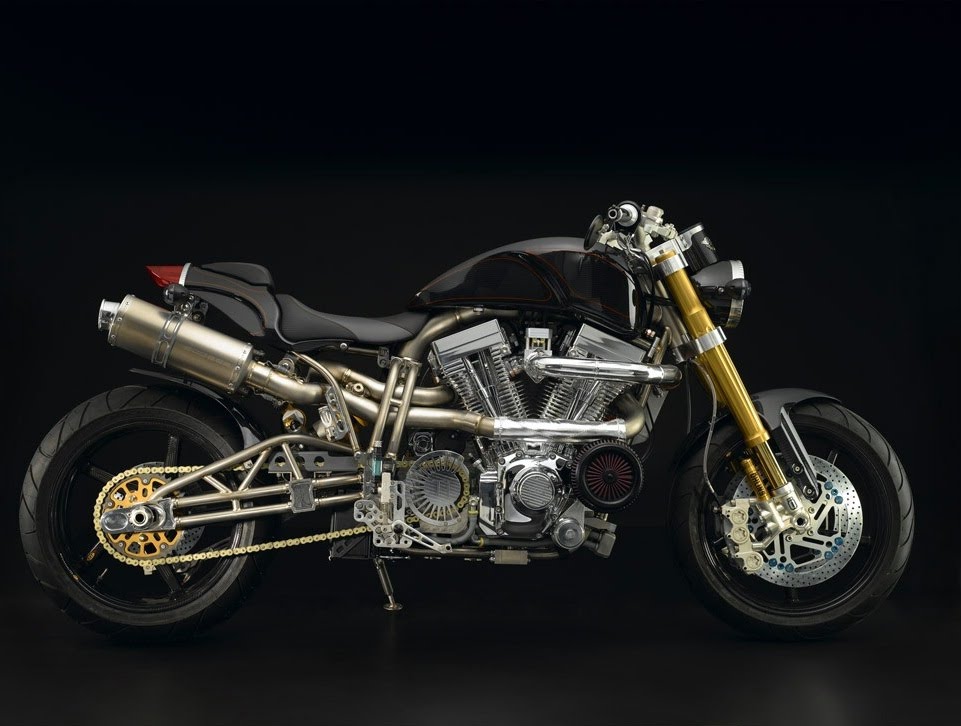
Cost - $275,000 (12372228 INR)
This limited edition bike is limited in the real sense. Only 10 units of the bike are manufactured. As the name suggests – limited edition, is a powerhouse when it comes to the capacity of the engine and the speed it generates. Sheer imagination is enough when you know that the bike has a 2150 cc engine with more than 200 hp. The bike has a watch, manufactured by French watchmakers BRM, which is made exclusively for this bike only.
Macchia Nera Concept Bike

Cost – $201,000 (9042974 INR)
The Macchia Nera concept bike happens to be one of the best bikes in this segment. The bike sports an engine that is loosely built around the Ducati 998RS engine. A side view of the bike will show you the structure of the bike. The engine is visible along with the detailed molding and the engine components.
However, the unique thing about the bike is that in spite of such a heavy built, it is extremely light – as far as the category in which it is built is concerned.
Icon Sheene

Cost – $160,000 (7198387 INR)
Icon Sheene was produced exclusively in the memory of Andrew Morris, who was one of the most successful British Grand Prix motorcycle champion. When he passed away, he was 52 years old. That is why only 52 of such bikes were produced. The bike has a 250 hp engine and has a whopping 1400 cc engine – nothing more than a flying experience.
The thing worth mentioning about this bike is that, in spite of being such a heavy bike, the Icon Sheene has only a couple of spokes in the wheels. Sounds strange and happening, but that is the fact.
MTT Turbine Super Bike

Cost – $150,000 (6748488 INR)
The second last bike in the series is the MTT Turbine Super Bike. MTT Turbine Super Bike aka Y2K Turbine Super Bike is not in the list for nothing. This bike is a combination of both most expensive and super fast bike. The bike also holds the Guinness World Record for being the most powerful motorcycle which has entered a series of production.
The engine has a power of more than 300 horse power. The unique thing about this bike is that it is loaded with various gadgets. It has a camera mounted on the rear, it has a LCD color display, it has a radar detector, a one touch ‘Smart Start’ among others gadgets.
MV-Augusta F4CC

Cost – $120,000 (5398790 INR)
The MV-Augusta F4CC was designed and created by Claudio Castiglioni, who was MV’s director. Certainly, this bike took birth through passion for having a bike that would not only be eye-catching but would also serve the purpose of the consumers of owning something different and unique.
The MV-Augusta F4CC can be driven at a maximum speed of 315 kmph which is around 195 mph. This tremendous speed can be achieved curtsey the 1078 cc powerful engine. It is also featured with 198 hp power generation. The model number of each bike is shown near the steering column.
Wednesday, March 9, 2011
Led-World Exclusive - Audi A6 will soon flaunt all LED headlamps
Nowadays one can see many cars fitted with those LED lights, but do any of you know who the pioneer of those cute yet smart headlamps was? So for your information, it was Audi, who basically started these LED headlamps with the launch of its all new (at that time) Audi R8. Anyways, now it seems that Audi is trying to get it even better with the Audi A6. Audi is trying to improvise on the same for its much praised Audi A6. Till now, car manufacturers use both LED with Xenon headlamps. So, it will be the first time when a sedan especially will flaunt an all LED headlamp cluster. Later on even the Audi A8 and Audi A7 will also join the club. Besides this, all LED headlamps, this car will still be offered with Bi-Xenon and Halogen headlamps also.
There are numerous reasons to choose a full LED headlamp over the normal Bi-Xenon or Halogen headlamps. Say for example these ultra powerful LEDs produce a strong white beam exactly like a day light but only consume not more than 4watts of energy. Because of the four one chip, five two chips LEDs the energy consumption is really low. These new headlights in the Audi A6 will also have an added feature which is high beam assistant and special adaptive light control. Wondering what’s that? It is one of the features that will make you drool for it for sure. These headlamps are directly connected to a camera facing forward which will continuously send signals to the headlamps about any change recorded in the ambient light. I guess you know what this headlamp will do. Yes, it will perform accordingly. So, it seems that Audi is really making head turns with its new inventions.
There are numerous reasons to choose a full LED headlamp over the normal Bi-Xenon or Halogen headlamps. Say for example these ultra powerful LEDs produce a strong white beam exactly like a day light but only consume not more than 4watts of energy. Because of the four one chip, five two chips LEDs the energy consumption is really low. These new headlights in the Audi A6 will also have an added feature which is high beam assistant and special adaptive light control. Wondering what’s that? It is one of the features that will make you drool for it for sure. These headlamps are directly connected to a camera facing forward which will continuously send signals to the headlamps about any change recorded in the ambient light. I guess you know what this headlamp will do. Yes, it will perform accordingly. So, it seems that Audi is really making head turns with its new inventions.
Future development trend of LED in car light

After the developing stage that LED car head-light is shown in technology proving, concept car that is gone through in recent years,etc., welcomed the expected prospect of entering the market of producing car of applying to amount at last, there are three its significant incident: Will Ling of Toyota LS600h in the world first to adopt, shine the listing bus of the light source in front of the LED, but it has employed LED only on the low beam light, the long-range light source is still a halogenic light. The Audi R8 regards the whole LED head-light as its main characteristic, LED adopted in and the car illumination is offering by Lumileds and Osram Company. Cadillac EscaladePlatinum platinum edition multi-functional sport car, it is first multi-functional sport cars which adopt LED head-light.
Hinder LED light source from opening up the unfavourable factor of the automobile-used market rapidly
Does the above-mentioned milestone incident mean LED head-light will set up horses and become innovative technology which will decide the automobile-used light source field? According to the estimation by experts: Perhaps can not. The cost that it is LED can drop continuously according to the prediction speed of one Mole of laws, it is low to can reach with HID for it to want ‘ The high strength discharges The equal price that the xenon lamp is equal to has been still needed for many years too; And it can be comparable to halogenic light if the cost of LED family should be dropped to, need to pass a period of longer time course.
Draw according to Hella sea Fischer, president of company, claim automobile-used scale of LED account for their light source the intersection of market and a few percent little share only at present, so to the type in enormous quantities correctly ‘ Style such as GM / Chevrolet Malibu fund of one Complete network supply utmost point interested in. But LED wants to reach to the stock level of Malibu style so in enormous quantities, still needs to overcome a series of technology and cost difficult problem, have course in ten years that will go at least.
Big the open paces that point out, LED enters the market are really a little slower than the ones that originally expected generation, we had predicted in 2004: LED the intersection of car and lantern fair blowout enters the market, and eliminate HID soon. Obviously, present situation to so, can expect the intersection of LED and technology fast a bit than reality gradual progress. It seems it is not the only factor of hindering LED from appearing on the market that the cost is high, still a challenge difficult problem of technical feature needs solving.
For example, in terms of single light source, the illumination intensity of LED still shows insufficiently. And can not reach followingly and satisfactorily and calculate only: It contributes to narrowing taking up the space and easy to be flexible to fix up of the car lamps and lanterns to cut down and form number of LED light source which makes the lamps and lanterns up, and can simplify and light systematic wiring and install and reduce the production cost.
The major state that LED supplies the chain is at present: It is bright Osram to draw LED light source component which supplies the common Cadillac Escalade style in the sea to the department of Europe Purchase; And small Zhyuan’s car light Koito LED last light source of the Companies products, be lasted LS600h style in Toyota and then; The intersection of Philip and Lumileds give AL the intersection of LED and the intersection of light source and supply ‘ The car lights The company, is and then disposed the car light system for the Audi R8 by the latter.
According to American-European manager of business department of Koito, they will not limit the kind of the light source and purchase the manufacturer for being firm and oneself rowing, no matter at whom does it produce in ‘ Philip, Ou department are bright, or Toyota Gosei Can all buy. Obviously, the flexibility that the first class suppliers who light the systematic part attempt to keep oneself purchasing the light source components and parts, want to observe it: Which device products technology of the manufacturer can progress fastest, the cost performance is highest.
LED criticize for the photoelectricity of the goods to change nowadays ‘ The light energy density The index reaches 80 lumen per watt ‘ 80lm/W The above, but HID light is 90lm/W, the halogenic light is 201m/W. According to another draw in the sea and notify: The latest LED researches and develops this index already up to 161lm/W of the prototype. Draw in the sea and also predict: During 3-5 years in the future, LED luminous intensity of releasing from the same consumption chip will be promoted by 50%. This not only means LED lamps and lanterns will be more bright but also reflect the cutting down of its energy consumption, thus improve the fuel economy of the completed car.
It is estimated, mileage that the ones that replace mpg per gallon of fuel that the halogenic lamps and lanterns can promote the completed car with LED go About 0.25 indexes. And when going to Europe to turn on the regulation of going of the light in the daytime, expand promoting value of this mpg to 0.5. Ling Zhi’s style manager points out, there will be very great contribution to employ LED lamps and lanterns economic improvement to fuel of completed car.
But strong the intersection of density and high LED want, give out more heat too only, and compactness of lamps and lanterns fix up, make the area suitable for dispelling the heat trend towards lightly again. It is much fewer than halogenic light or HID lamps and lanterns that the ones that belong to low energy consumption LED device of the semi-conductive classification truly generate heat, but the majority of the latter’s heat is turned into not including the lamps and lanterns device, and LED although low power dissipation grow hot to want, seal, come on, conduct inside small silicon chip heat while being little.
The hot management of LED is a great difficult problem
Even smaller heat will concentrate to go up to the chip size device conducted and dispersed, because the heat capacity of the device is small will cause the rising suddenly of LED temperature. The working temperature of LED must keep in 150 ranges of under ℃. A kind of solution to this heat-dissipating problem is: Use the intersection of number and more LED give out light component in one lamps and lanterns, let the single caloric value of one be relatively little, it makes it apt to dispel the heat to and then fix up them in the larger space. Tactics adopted at being small the intersection of Zhyuan and car light for will LS600h related head-light Ling of Toyota this.
Cadillac EscaladePlatinum each head-light is formed by 7 LED fluorescent lamps, 5 among them are used in light beam of short range, another 2 are regarded as the long-range light source. They all have their own active heat-dissipating devices –Cool the fan ‘ Similar to disposing the small fan in the desk-top computer .
Draw and claim, it is a design field especially bothered about and troubled by them that heat is managed according to the sea, lay particular emphasis on relying on the fictitious artificial means to assess optimizing in the scheme is chosen, and is imitating tools ‘ Artificial software package If you can’t select to use, pass by textual criticism of experimental datas enough. Point out he,for heat last heat-conduction challenge of problem of management not merely,can with the aid of ” The hot pool ” The device gets the heat that LED component produces out, and will solve and ventilate the problem, let heat distribute out of lamps and lanterns device. If it is not obviously enough to only depend on natural ventilation, so draw the decision and add the built-in fan for the lamps and lanterns in the sea
Monday, February 28, 2011
Comparison - Led-vs-Fluorescent-vs-Incandescent

If there’s one constant in this world, it might just be that technology is always changing. The second you feel as if you may finally have a handle on it all, it changes so much that you have to just about start at square one. The same goes for lighting. Lamp technology has changed so much in recent years that knowing which ones to include in a kit has become as difficult as solving world hunger. That’s why we’re going to look at some of the newest and best light fixtures for incandescent, fluorescent, and LED and give you some tips on which lights work best for every type of video production. Though we can never show you the exact lighting kit to buy for your needs, hopefully we can point you in the right direction.
Incandescent
Unfortunately, there is precious little to say that would make incandescent bulbs look good. They produce a lot of heat and guzzle power like a Hummer guzzles gas. These features don’t bode well for the incandescent’s future, but there is one redeeming quality: incandescent bulbs are still the brightest lamps money can buy. They are also some of the cheapest fixtures on the market today. If you need something that can compete with the strength of the sun or light the inside of an entire house, then incandescents and HMI’s are really the only way to make it happen.
Though I do my best to be good to the environment, I have to admit that I still use incandescent PARs like Smith Victor’s A80 or Lowel’s Omni and DP as the backlight in my three-point lighting setups. I just find it too hard to get the rim light strong enough while still keeping the fixture out of the shot using any other type of lighting fixture. Also, for background washes, I still use a Lowel Tota light with a 750W bulb or a Cool-Lux Hollywood Soft Light with a 1000W bulb. These fixtures combined with gels and cookies give me the light intensity and look I need for backgrounds in larger scenes. Lighting the same scene with fluorescents or LED lamps would require several fixtures, making it more difficult to get wide shots without stands in the frame and of course, making it more expensive too.
The other advantage of using incandescent-style bulbs is that I can dim the lights without ballasts by using a heavy-duty light dimmer available from any home improvement center. This makes light dimming affordable, but does change the color temperature of the light when dimmed. However, I am usually able to live with the results.
The most affordable incandescent lights on the market right now come from Lowel, Smith Victor, and Cool-Lux which sell great interview lighting kits for a good price. If you’re looking for lights that industry professionals use most often, both ARRI and Mole-Richardson offer some high-quality lighting kits as well. Depending on what you’ll be using these lights for, there should be a light amongst these manufacturers that fits your needs.
Fluorescent
On the other hand, fluorescent bulbs produce very little heat and draw less than a quarter of the power of similar incandescent lights. They are generally very soft lights and tend to look great as key lights for interviewing subjects. The biggest problem with this lamp type is that they can’t be dimmed by a simple variable resistor dimmer. Since fluorescents work by using bursts of electricity to fluoresce gas inside of a tube, cutting down on the amount of electricity to the fixture will either make the light blink or turn off altogether. This means that the only way to dim fluorescent lights is to use a ballast which makes the fixtures fairly large and cumbersome. That’s why these kinds of lights are typically used in studios rather than field work. We actually use fluorescent lights from Kino-Flo such as their 4-Bank and DivaLites to light our green screen and subject in our studio. That being said, companies like Kino-Flo have been hard at work putting together systems, like their Barfly, that are easier to use in the field. These kits usually have fluorescent lamps with ballasts built right into the unit along with hard cases to withstand the frequent abuse of using lights on the road. In fact, many major networks are now using fluorescent fixtures for their studios since it saves so much on cost and generally casts a pleasing soft light on their anchors.
Some of the best fluorescent light fixtures can be found at Kino-Flo and FloLight, who have been in the industry for a while. You can also check out Videomaker’s review on the Kino-Flo Barfly to see for yourself what these fixtures can do.
LED
Of all of the lighting technologies, the most promising is the LED. LEDs are an answer to many of the problems gaffers had with incandescent light fixtures. LEDs are small, lightweight, produce almost no heat, draw very little power, can be dimmed without changing color temperature, and can even go between color temperatures at the flick of a switch. With all of these features, it’s no wonder that LED fixtures seem to be the Holy Grail of video lighting.
The only real problem with LEDs are their limited light intensity. Even the strongest LED lamps fall woefully short of the amount of lumens an incandescent lamp can throw on a subject. That’s why LEDs are most often used as key and fill lights in interviews, and on-camera lights since the fixtures can be placed close to the subject in these situations. With the way technology advances in the world of LEDs, I can only imagine that it’s just a matter of time before these lamps begin to equal those of incandescents. In fact, some companies such as LitePanels with their Sola, and ARRI’s L-Series Fresnel concept are now making LED fixtures that are just as bright as similar incandescent fixtures.
Even so, LED light fixtures are hard to beat for field shooting. They are lightweight, can take a decent amount of abuse, and can run off of battery power for long periods of time due to their low power consumption. Lights like these have become very popular at trade shows and events where lighting is usually less than ideal and space is limited. This last year at CES, I saw dozens of people using LED fixtures like the LitePanel 1×1 with an external battery pack for quick interviews and product shots. Many energy conscious studios and buildings are using them too. The White House Press Briefing Room saw their energy consumption drop 95% after using LED fixtures. Even prime time television shows such as Fox’s 24 used LEDs to light parts of their set.
Though only a handful of companies once sold LEDs, most brand name manufacturers have jumped on the LED bandwagon. Kino-Flo’s website has a coming soon page for LED lighting kits, ARRI now sells LoCaster LED fixtures as well as hybrid LED kits, FloLight sells Microbeam LEDs in both a small and large form, Mole-Richardson has a MoleLED concept light that is soon to be released, and Lowel introduced their Blender which can switch between indoor and outdoor color temperatures. Videomaker has also had the privelege to review some of the more interesting LED lights over the past couple of years including the ARRI H-2 “Hybrid” kit, and the LitePanel 1×1 Bi-Color light, both of which are dimmable and can switch color temperatures. Though many of these lights can be more expensive than their incandescent counterparts, the flexibility and energy savings they give is almost always worth the cost.

Monday, October 18, 2010
LED-Next-generation bulbs to capture nearly 50% of lighting market by 2020

A new report finds that the market for light-emitting diodes (LEDs) is set to explode in the next ten years, surpassing even compact fluorescent lightbulbs as the ultimate energy-efficient lighting option.
By 2020, LEDs will cover 46 percent of the $4.4 billion U.S. market for lamps in the commercial, industrial and outdoor stationary sectors, driven by the overall push toward energy efficiency, according to a study released this week by Pike Research, a Boulder, Colo. cleantech market-research firm. That's a big jump, considering that LEDs now capture only two percent of the lighting market, according to estimates.
"As energy efficiency becomes increasingly important for controlling costs, improving energy independence, and reducing environmental impacts, governments and organizations have looked to lighting as the 'low hanging fruit' of energy efficiency," the study states.
Currently, lighting accounts for 17.5 percent of the world's electricity consumption, and $40 billion of the electricity bill in the United States, which makes it full of potential for energy and cost savings. While fluorescents have been justly praised for offering greater efficiency than incandescent bulbs, LEDs have been shown to be more efficient and to last longer than any other lighting source on the market, making them the logical next step.
LED lightbulbs typically last 50,000 hours — twice as long as fluorescents — and are up to twice as efficient as fluorescents, which are four to six times more efficient than incandescents. Further, unlike fluorescent or incandescent bulbs, LED tubes do not get especially hot.
According to a 2009 report released by market research group GigaOmPro, incandescent bulbs only convert about 4 to 6 percent of the energy they receive into light; the rest is wasted as heat. While fluorescent bulbs can raise the temperature in a room by up to two degrees, resulting in increased cooling load for buildings, LEDs don't raise the temperature at all.
"Growth rates [for LEDs] have been in the double digits and we don't anticipate growth to slow,," writes analyst Katherine Austin in the GigaOm report.
"With a new administration in the U.S. White House, a new energy secretary, and a new focus on energy efficiency, market conditions for are very likely to remain positive. Other countries, especially China, Korea and Japan, share this focus. By 2012, the market for LEDs in general lighting applications could climb as high as $10 billion, although in light of the recent economic downturn, we expect that $4-5 billion may be more realistic."
In addition to their high efficiency and long lifespan, LEDs also do not require ballast and do not contain toxic mercury, which means disposing of them when they die poses fewer health and environmental hazards.
LEDs are also favored by the Department of Energy, which has been investing heavily in advancing the technology over the last ten years. The European Union is currently phasing out the use of incandescent bulbs, which the U.S. will do in 2012, leaving only fluorescents and LEDs left as the lighting options.
Cost is Chief Barrier
Despite the positive forecast, there remain short-term financial and technological obstacles to market success for LEDs, with the biggest problem being price.
LED tubes cost anywhere from $50 to $100, compared to $2 to $10 for fluorescents. The other roadblock frequently cited by electrical engineers and facilities managers is brightness; they are concerned occupants will complain that the lights are not bright enough. Both problems are being addressed by LED manufacturers, which are researching ways to increase the luminance of LEDs and cut costs.
In 2008, for instance, researchers at Purdue University found a way to replace the expensive standard substrate used in LED production — sapphire — with low-cost, metal-coated silicon wafers. The switch would greatly reduce the cost of LED manufacturing, assuming another silicon shortage does not come along.
Even without a cost breakthrough, though, reports suggest that paying more for LEDs would be worth it. In a recent LED-to-fluorescent comparison, Greentech Media found that while LEDs are clearly more expensive at first, they are far more cost-effective in the long run.
Comparing an installation of 40 LEDs and 40 fluorescent tubes, the report found that in the first year it would cost $3,069 for the energy and initial purchase of LEDs, while the fluorescent tubes would cost $1,071. Given that every year thereafter the energy costs of the LED tubes would be lower than fluorescents — $269 versus $431 — the analysis found that after 16 years the LEDs offered a six percent cost savings.
Still, as with most green building products, the long-term cost savings of LEDs won't necessarily convince building owners right away. It's likely to take awhile for them to warm up to the idea that they should increase their lighting budget by a few thousand dollars, even if it means reducing their energy bills.
In the meantime, during the ten years the study predicts it will take for LEDs to overcome obstacles to their adoption, fluorescents will continue to replace incandescents, the authors say. To fill that future market demand, companies are emerging with controllers and sensors to help boost the efficiency of flourescent bulbs.
Cavet: 'Save Energy and Money Now'
One such firm is the venture-backed Toronto company Cavet Technologies, which recently launched its LumiSmart Intelligent Controller, a device that connects directly to lighting circuits and automatically adjusts voltages to improve efficiency.
With its 'save energy and money now' approach, Cavet is likely to be appealing to building owners.
"A 100,000 square foot property can be outfitted with LumiSmart in one afternoon and benefit from an immediate savings of 30 percent with an ROI payback period of between 12 to 24 months," Albert Behr, president and CEO of Cavet Technologies, told SolveClimate.
According to the company, a single LumiSmart ILC can manage lighting loads of up to 6.9 kilowatts, or around 130 fluorescent lights. The product provides power savings by altering the power waveform and then applying what Cavet calls an "adaptive power factor correction." By inserting on-off pulses into the sine wave, LumiSmart is able to dramatically reduce electrical consumption with minimal impact on lighting levels.
So far, Cavet has caught the eye of venture capitalists and as-yet-unnamed utilities in Canada, Europe and the U.S., all eager to test the company’s controller. It also won praise from cleantech analyst Dallas Kachan, former managing director of The Cleantech Group, who released a positive assessment of the company via his market research firm, Kachan & Co, last week.
The key benefit of Cavet's controller, analysts say, is that it is relatively inexpensive at $2,000 per controller and is quick and easy to install. While it still needs to be installed by an electrician, it's about as plug-and-play as such a device gets, the company says.
"There are other lighting controllers, but they generally take a lot of time and money to install, so the more lights an organization has, the more expensive these other solutions are," Kachan says in the company’s launch video.
The LumiSmart product has been in trials throughout Canada and Europe during the last year, including at the Canadian headquarters of electronics manufacturer Celestica, which is both making and testing the product.
At the LumiSmart product launch earlier this month, Cavet executives showed on stage how their product had delivered a 40 percent energy savings at the manufacturing facility.
Later this year, the firm plans to release a related demand-and-response product, which will allow property managers and utilities to set building lighting systems to automatically power on and off, and dim, according to the availability and price of electricity.
Others Hedging Their Bets Elsewhere
While Cavet is focused for the time being on making fluorescents more efficient, another smart lighting company, Siemens spin-off EnOcean, is hedging its bets by focusing on controlling and automating lighting—no matter the light source.
EnOcean's sensors, transmitters and controllers have ultra-low energy requirements, allowing them to run off of so-called "harvested energy" from ambient light, sunlight and electrical cables.
For its part, U.S. industrial giant General Electric has decided that it's going to be ready and waiting when the residential LED market blows up. The company recently announced the late 2010 or early 2011 release of its LED bulb shaped like an old-fashioned incandescent bulb. Although GE is not the first company to figure out how to make LEDs more "bulb-like." the fact that the inventor of the bulb is making an LED version is big news.
GE's bulb is guaranteed to last 17 years and consume only nine watts of power, delivering a 77 percent energy savings over incandescent bulbs.
Early adopters will likely rush out to buy the bulb, but with a price tag of $40 to $50 each, the costs could remain a barrier to widespread market penetration.
Monday, October 4, 2010
LED Lighting industry experts on an analysis of the future
LED lighting, with its obvious advantages, as highlighted by the new energy industries. In Taiwan, Huang Chao-crystal electric Vice Chairman pointed out that the LED will lead to more future new applications, and the use of new packaging technologies and chip to lower production costs and improve luminous efficiency.
Cree Asia-Pacific vice president Li Shiyi said LED lighting industry in the future growth rate depends on the market for LED luminous efficiency of the acceptance, product quality and innovation may be another, but also with policy factors, such as the International Solid State Lighting LED on the brightness, and security norms.
LED general lighting market is customer demand has been low the past the requirements of the brightness and gradually turned to quality, environmental protection, and comfort requirements, the estimated future green LED will be more demand, prices will drop to 1.3 times the traditional lamp about standards.
Everlight vice president of global business StephanGreiner said that at present the world’s leading LED lighting market concentrated in the Asia Pacific region, accounting for 33.7% of the global market, North America, second place, accounting for 30.1%, followed by 22.3% in Western Europe, Eastern Europe, accounting for 5.1% , Africa and the Middle East about 4.5%, estimated global market size of about 85 billion U.S. dollars, in the applications of other areas, mainly family-oriented, accounting for about 39%, followed by office and medical-European 18%, the third largest outdoor market lighting, about 12%.
StephanGreiner that outdoor LED lighting market has considerable room for growth, especially in fast-growing Chinese market, now accounting for outdoor LED lighting market in the world 38%, exceeding the 33.3% in North America.
According to market research firm iSuppli’s latest report and StrategicsUnlimited, 2011, total global LED lighting market will reach 90 billion U.S. dollars, 2011, the global high-brightness LED driver IC market is expected to more than 1.9 billion U.S. dollars, in 2010 LED lighting market in China is expected to reach 30 billion yuan, nearly 16 billion yuan in 2006 doubled. LED is the current recession in which electronic components industry as a whole bunch of valuable light of hope, LED is expected to achieve about 3% this year, sales growth, while the overall global semiconductor market this year, down 9.4%.
French market research company Yole predicts that by 2012, the overall LED market will reach 10.3 billion U.S. dollars. Among them, high brightness and high brightness LED total will reach 4.45 billion U.S. dollars, almost 783 million U.S. dollars in 2007 forecast to 5.5 times.
According to ABIResearch’s research branch NextGenResearch, global LED lighting market in 2013, annual output value is expected to break through 33 billion U.S. dollars. LED lighting market in the period 2009-2013, the average compound annual growth rate (CAGR) will be close to 22%.
The largest LED lighting market is the LED backlight (laptop, PC, LCD-TV and mobile phone), LED general lighting market has entered a fast development track, especially in the lights, car tail lights, automotive interior and small Biaoshi lights, construction external decorative lighting materials, government agencies (as well as jewelry stores and airports, and other special public place) the internal general lighting, outdoor and indoor LED displays, such as household lighting, household lamp, LED fluorescent lamp LED market has started.
For example, Chongqing, Wuhan and Suzhou, and other small cities and the high-tech industrial parks have been built all use LED lights in the park road, in some cities (such as Suzhou) is the direct deployment of solar powered LED lights. U.S. LosAngles will all use LED lights, Minneapolis intercontinental highway will also use LED lights.
Osram Asia Pacific Regional Director Zhongjie Cong said, OLED is an important development of LED lighting direction, however, OLED performance increase will take some time, estimated by the high-end market, OLED will gradually go mass market. Veeco Instruments MichaelLamarra product manager, said a growing number of LED backlight to replace CCFL, lighting applications are growing, estimated to LED packaging costs in the next six years, down 85%, LED plant needs to reduce operating costs and increase productivity while out. LED’s strengths and its competitiveness significantly to our confidence in its future.
Cree Asia-Pacific vice president Li Shiyi said LED lighting industry in the future growth rate depends on the market for LED luminous efficiency of the acceptance, product quality and innovation may be another, but also with policy factors, such as the International Solid State Lighting LED on the brightness, and security norms.
LED general lighting market is customer demand has been low the past the requirements of the brightness and gradually turned to quality, environmental protection, and comfort requirements, the estimated future green LED will be more demand, prices will drop to 1.3 times the traditional lamp about standards.
Everlight vice president of global business StephanGreiner said that at present the world’s leading LED lighting market concentrated in the Asia Pacific region, accounting for 33.7% of the global market, North America, second place, accounting for 30.1%, followed by 22.3% in Western Europe, Eastern Europe, accounting for 5.1% , Africa and the Middle East about 4.5%, estimated global market size of about 85 billion U.S. dollars, in the applications of other areas, mainly family-oriented, accounting for about 39%, followed by office and medical-European 18%, the third largest outdoor market lighting, about 12%.
StephanGreiner that outdoor LED lighting market has considerable room for growth, especially in fast-growing Chinese market, now accounting for outdoor LED lighting market in the world 38%, exceeding the 33.3% in North America.
According to market research firm iSuppli’s latest report and StrategicsUnlimited, 2011, total global LED lighting market will reach 90 billion U.S. dollars, 2011, the global high-brightness LED driver IC market is expected to more than 1.9 billion U.S. dollars, in 2010 LED lighting market in China is expected to reach 30 billion yuan, nearly 16 billion yuan in 2006 doubled. LED is the current recession in which electronic components industry as a whole bunch of valuable light of hope, LED is expected to achieve about 3% this year, sales growth, while the overall global semiconductor market this year, down 9.4%.
French market research company Yole predicts that by 2012, the overall LED market will reach 10.3 billion U.S. dollars. Among them, high brightness and high brightness LED total will reach 4.45 billion U.S. dollars, almost 783 million U.S. dollars in 2007 forecast to 5.5 times.
According to ABIResearch’s research branch NextGenResearch, global LED lighting market in 2013, annual output value is expected to break through 33 billion U.S. dollars. LED lighting market in the period 2009-2013, the average compound annual growth rate (CAGR) will be close to 22%.
The largest LED lighting market is the LED backlight (laptop, PC, LCD-TV and mobile phone), LED general lighting market has entered a fast development track, especially in the lights, car tail lights, automotive interior and small Biaoshi lights, construction external decorative lighting materials, government agencies (as well as jewelry stores and airports, and other special public place) the internal general lighting, outdoor and indoor LED displays, such as household lighting, household lamp, LED fluorescent lamp LED market has started.
For example, Chongqing, Wuhan and Suzhou, and other small cities and the high-tech industrial parks have been built all use LED lights in the park road, in some cities (such as Suzhou) is the direct deployment of solar powered LED lights. U.S. LosAngles will all use LED lights, Minneapolis intercontinental highway will also use LED lights.
Osram Asia Pacific Regional Director Zhongjie Cong said, OLED is an important development of LED lighting direction, however, OLED performance increase will take some time, estimated by the high-end market, OLED will gradually go mass market. Veeco Instruments MichaelLamarra product manager, said a growing number of LED backlight to replace CCFL, lighting applications are growing, estimated to LED packaging costs in the next six years, down 85%, LED plant needs to reduce operating costs and increase productivity while out. LED’s strengths and its competitiveness significantly to our confidence in its future.
Friday, February 26, 2010
LED Stuff - Rocking The World !!!
LED Stuff - Rocking The World !!!

The innovation in electronic devices has always driven a good market all over the world. When incandescent bulbs were being replaced by CFLs, another technology was pushing its head to replace the newest one–LED. Light Emitting Diode technology has now emerged as a major replacement in many products and has changed the perspective of electronics consumer market. In this article, we provide comprehensive knowledge about LED, its applications, products, market scenario, industry overview and what’s there for new players who want to enter into the business of LED products.
What is LED
LED or Light Emitting Diode can be understood as an electronic device that gets lighted up while passing electricity through it. LED is a semiconductor light source used as indicator lamp in a number of devices. Today, LEDs are increasingly used for general lighting purpose. In the year 1962, LED found its place into the electronic industry as a practical electronic component. During its early stages, LEDs emitted low-intensity red light. With the advancements in technology, today we find a number of versions of LEDs including visible, ultraviolet and infrared wavelengths offering very bright light. Also, the fact that LEDs are small in size makes them a good choice to display images. LEDs do not burn out like other lights, while they burn on significantly lower power compared to conventional light sources.
There are a number of advantages in LED when compared to incandescent light sources. Some of them are longer lifetime, enhanced robustness, quicker switching, lower energy utilization, smaller size, more durability and reliability. On the other hand, LEDs need an accurate heat and current management as against conventional light sources. Also, the market price of current LED products is expensive when compared to the fluorescent lamp sources of equivalent output.

Basics and History of LED
LEDs are based on the principle that a semiconductor chip emits light while conducting current through it. LEDs are deemed highly versatile with regard to their capacity to emit almost all spectrums of light. As a diode is switched on, electrons are made to recombine with holes in a given device resulting in the release of energy that is available in the form of photons. Called as electroluminescence effect, the process emits light in different colors depending on the gap of the semi conductor. Usually, the diodes of LED are spaced less than 1mm or 2mm. There are a number of integrated optical components used to shape the resulting radiation pattern and to help in reflection.
Though LEDs that emit a practical spectrum of visible light are being developed since 1960s, it is only recently that LED technology is able to produce lighting sources that are able to emit acceptable levels of illumination which can effectively replace the conventional primary lighting sources in homes and businesses. Today, LEDs are increasingly finding their applications across a diverse range of lighting requirements to replace the conventional light sources. Especially, the prominent applications of LEDs include indicators and traffic signals. Since 2007, Airbus has been using LED lightning in its A320 aircrafts, while Boeing has plans to use the same in the 787.
Over and above, the smaller size of LEDs has enabled the development of innovative text and video displays and sensors, while the high switching rates of LED comes as a welcome factor in using LED in the arena of advanced communications technology. Called as Solid State Lighting (SSL), a new phase of innovative technology in the arena of LED illumination is seen developing at an amazingly fast pace. For instance, the latest bulbs that we can see in the market from EarthLED did not exist a year ago.
How it works
LEDs are commonly seen around us in a number of gadgets. LED is a semiconductor diode that emits light under the process of electroluminescence while passing current through it. In this process, the semiconductor works as the medium for the electrons to move and fall into other energy levels during their transit across the p-n junction. As the electrons jump to a lower energy level, they emit a photon of light. This photon or pack of light might either be in the infrared or ultraviolet or anywhere within the visible spectrum of light. Therefore, we need to pick up a color when we manufacture them to meet our varied requirements. Usually, LEDs are manufactured to emit one color of light, though manufacturing bicolor ones and others can easily be done. In addition, there are ways to increase the intensity of light as well. Therefore, the possibilities of broadening their application in the lighting arena are enormous.
LEDs found in normal applications are not at all voltage dependent. LEDs are manufactured according to the buyer’s color needs. Red, green and blue are the most popular colors in LED, while there are also other colors possible. Big LED color displays make use of a three-LED pixel. With this system, a number of colors can be obtained by driving them in the 3-LED assembly.
Classification of LED
One can classify LED products according to light emitting colors, diode structures, outer surface features, luminous intensity, chip material, function, and operating current, etc.
Colors of the diode:
LEDs are available in red, orange, green and blue in addition to several others. Under green colors, there are three types including pure green, standard green and yellow-green. There are also a few light emitting diodes or chips that can emit two or three colors. Also, the plastic body can be designed in many ways with or without a scattering agent, colored or colorless and so on. Therefore, the resulting classification of LEDs based on the color can be understood under four heads namely colored transparent, colorless transparent, colored scattering and colorless scattering.
Outer Surface features:
According to the features of the outer surface, LEDs can be classified into round, square, rectangular, surface LED, side LED and surface mount subminiature LED besides a number of others. Round LEDs come in different diameters ranging from φ2mm、φ4.4mm、φ5mm、φ8mm、φ10mm and φ20mm. Round LED manufactured with a diameter of φ3mm is usually referred as T-1, while φ5mm is noted as T-1(3/4) and φ4.4mm is noted as T-1(1/4).
Types according to the angle distribution of the luminous intensity:
There are three types of LEDs based on the angle distribution of their luminous intensity. A) High directivity LEDs are packed either in sharp head epoxy packaging or metal reflection cavity packaging. Usually, they are available without light scattering agent. The viewing angle of this kind of LED ranges from 5° or 20° or even smaller. These types can find their use as local illumination source or to construct an automated detecting system combined with a light detecting device. B) Standard type LEDs are usually found in indicator lamps with the viewing angle varying between 20° and 45°. C) Scattering type is generally used as indicator lamps that require comparatively larger viewing angle ranging from 45° to 90° or even larger. This type makes use of more light scattering agents than the other two types.
Based on their structure, LEDs can be classified as full epoxy resin packaging, ceramic base epoxy resin packaging, metal base and glass packaging.
According to the luminous intensity, there are three types of LEDs namely standard brightness LED (where luminous intensity is less than 10mcd), high brightness LED (where luminous intensity is between 10mcd and 100mcd) and ultrahigh brightness LED (where luminous intensity is more than 100mcd).
Based on the power that operate LEDs, they can be classified into two types namely the standard type that works on an operating current ranging from more than ten mA to tens mA; low current LED which is operated at an operating current below 2mA (In this case, the brightness is almost same as the standard LED type).

Types of LED products
1. LED Lighting Applications
Manufactured using an appropriate technology, LED can be used as a better alternative to replace a number of conventional lighting gadgets. Though the concept started its voyage primarily as indicator lights, today LEDs have found versatile application across a wide range of lighting requirements. The three main areas where LED has come as a one stop solution to the lighting requirements are traffic control devices covering barricade lights, stop lights, pedestrian signals and road hazard signs; variable message signs that display information regarding commodities and news and in automotive applications.
LED Cove Lighting is one of the fast growing applications where LED is used for hard to reach lighting applications, which would bring down maintenance costs and hassles. In several regards, LEDs are more advantageous than fluorescents and cold cathode lighting. To mention one of the most suitable examples of this application, one can mention the Atmosphere product of Albeo Technologies. This is deemed as the best example for SSL cove light that is highly preferred in terms of price, performance, installation methods, uniformity and durability.
SIGN and Display Applications:
LEDs enjoy a number of incredible advantages over traditional fluorescent sign lighting. Some of the unique features of LEDs that are useful to this arena include their Visibility, durability, enhanced efficiency, and unbelievably less maintenance. Most interestingly, LED Initiative in this field has offered the best back and internal signage lighting solution for real time applications.
2. LED applications for Museums:
LEDs do not have the hazards of forward heat and UV radiation, which renders it the best alternative for sensitive artworks meant for museums. Tested replacement SSL lamps are deemed the best for retrofit applications at museums.
LEDs for Office Lighting:
Using LED lighting fixtures at offices remove tough maintenance requirements and the concerns regarding tiring fluorescent lighting. While there is no need to store lamps and ballasts at offices, LED lighting also helps keep the workforce feel pleasant and more productive. Greenlight Initiative in the LED arena have significantly brought down the power consumption of lighting gadgets used in the office spaces by as much as 40% over the conventional incumbent fluorescent systems.
Hotels and Restaurants:
While the lighting requirements are always lit type, LED lighting products come to the rescue by enormously bringing down operating costs. LED lighting solutions have the advantages of being highly versatile besides meeting the requirements of bright or warm, colorful or crisp. The longevity and bright appearance of LEDs can add elegance to the establishments besides reducing the operating expenses to the bottom line.
Stairwell Lighting:
Stairwell Lighting is often required to be kept on round the clock though used infrequently. LEDs have come as a solace for the building operators and management companies who rely on the products to save up to 60% of energy while ensuring continuous safe lighting levels. Over and above, LEDs are useful in applications including elevators, corridors and other similar infrastructure where the lighting adds up to the terra Watts of disused energy waste.
Over and above, applications including outdoor, pathway, security and cold weather render fluorescent lighting useless. LED lighting solutions can effectively replace the high maintenance options like HID or halogen lighting thereby ensuring unparalleled maintenance savings. LEDs have also started meeting the typical lighting requirements of parking lots and garages, hospitals and healthcare facilities, factories and large facilities, roadway lighting and bridges and tunnels.
With the evolution of solid state lighting, LED technology can effectively replace most of the conventional lighting on the planet. This can help in making enormous energy and maintenance savings in addition to bringing down carbon emissions to unprecedented low levels.

1. Long Life
Industry estimates say that all LEDs can enjoy a 50,000+ hour lifespan, when you will have to buy more than 50 regular incandescent bulbs or 5 compact florescent bulbs. LEDs do not have ignition hassles while it can work under a harsh condition of -40oC to +45oC. Since LEDs do not have filaments or tubes that might break, they are more durable. LEDs are encased in unbreakable high strength optical grade resin. Since there is no glass or filament that will break, LED light sources come as perfect solutions for lighting environments that are rugged or installations that are difficult to access.
2. Energy Efficiency
LEDs are burn on far less energy when compared to standard light bulbs, thereby bringing down energy costs. Also, LEDs need far less energy to manufacture at the industries when compared to other light sources, thereby once again bringing down the environmental impact of artificial lighting. The most powerful of LED replacement bulb consumes only 10 watts of electricity while performing equal to that of a 100 watt incandescent bulb. Moreover, conventional incandescent bulbs waste 98% of their energy by generating wasted heat, whereas LEDs generate very little heat. Also, the low power requirements of LED lighting gadgets make them ideal options for solar or wind powered installations.
3. Environmentally Friendly by Design
LEDs are considered the most environmentally friendly light source next to pure sunlight. Since LEDs do not use any hazardous substances in manufacturing, they are always RoHS compliant (a strict new standard meant to reduce hazardous substances).
4. Pure Light
LEDs come in white and warm light color temperatures. Irrespective of the temperature that we choose, we are assured of getting pure and clear light that renders reading or viewing objects easier to our the eyes.
5. Better Safety and Security
LEDs produce low levels of heat and burn on low voltages. Therefore, they are deemed perfect and safer sources of light. With LEDs, we do not have any glass to break. There are no concerns regarding hot filament, gas or candle flames and noxious fumes.
Industry Overview of LED
For quite some time since 2004, the high-brightness LED market witnessed a slow-growth phase as a result of the dominant position enjoyed by the mobile appliance market. However, the latter has come to a saturation point now. LED market experienced an overall uptick in growth from the year 2007. Still it continues to perform well and a range of its emerging applications promised the resumption of higher growth in the immediate future.
The global LED industry is seen to be clustered in Japan, EU and Taiwan. While Japan ranks first in the segment, Taiwan follows it. Philips and OSRAM are the backbones of LED sector in the EU. Top players in the LED industry in Japan include Nichia, Toshiba, Showa Denko KK, Sharp, CITIZEN and Toyoda Gosei. CREE is notable in the U.S.A.
LED industry is found highly dispersed in the mainland of China while we find thousands of LED manufacturers are found engaged in in LAMP packaging. Some of the dominant companies in this segment include Xiamen Hualian, COTCO Luminant Device (Huizhou), Jiangxi Lianchuang Optoelectronic, Ledman Optoelectronic, Golden Valley Optoelectronics, Foshan NationStar, Wenrun Optoelectronic, Ningbo Hepu Optoelectronic, Tianjin Tianxing Electronic, Refond Optoelectronics, and Leadfull Optoelectronic, besides a number of others. There are also the key manufacturers of LED including San’an Photoelectric, Dalian Lumei, Silan Azure, Epiligh Technology and Rainbow.
LED lights for numbers and alphabets
What is the market potential of LED products?
Over its development as a visible lighting source over the past three years, there is never a sign of slowing down in the LED segment. Though the Blue LED is available in production quantities only recently, they are expected to bring about an entire generation of innovative applications. Blue LEDs are known for their high photon energies (>2.5eV). They are also reported to have low eye sensitivity. The technology required to make these LEDs is very different and less advanced when compared to other LED materials. The blue LEDs available in the market today come with GaN (gallium nitride) and SiC (silicon carbide) construction with the brightness levels exceeding 1000mcd at 20mA. Blue is one of the primary colors apart from red and green. Therefore, blue LEDs will find their commercially viable applications in full color solid state LED signs and TVs in addition to medical diagnostic equipments and photolithography.
There are also enormous possibilities to manufacture other colors with the help of the same basic GaN technology and development processes. For instance, a high brightness green LED of about 500nm has been evolved, which is at present being evaluated for replacing the green bulb used in traffic signals. Other colors of LEDs that are possible include purple and white. Since blue LEDs have been introduced only recently, now the industry has the possibility to manufacture white by selectively combining red, green and blue light sources. This process might however need sophisticated software and hardware design to be commercially viable. One challenge in this segment is that the overall light output of each RGB might degrade at a different rate resulting in color unbalance over a period of time. There is yet another approach being implemented to achieve white light namely using a phosphor layer (Yttrium Aluminum Garnet) on top of a blue LED.
Today’s LED market can be identified under three segments namely general lighting, TFT-LCD backlight, and signal or data display, while TFT-LCD backlight is the most potential and rapidly evolving sector. The year 2009 saw a significant enhancement in LED luminescence efficiency and cost reduction, LED has started growing up strongly in the large-size sector. In the LED laptop field, the innovative designing of Dot typed light guide plate has effectively replaced V-cut design, thereby significantly bringing down the cost.
LEDs have already developed from infancy to adolescence and are witnessing the fastest market growth. By employing InGaAlP material along with MOCVD during the process of development and by combining it with efficient delivery of generated light and effective management of supplied power, the industry has today achieved some of the brightest, most efficient and highly reliable LEDs. In combination with other novel LED structures, this technology will ensure a wider application of LEDs across a variety of platforms. In addition, recent developments in the LED blue spectrum and white light will also ensure the continued growth in applications of LED light sources.
International scenario of LED Industry
In the year 2005, the LED industry was valued only at $205 million. Industry experts estimate that by 2011, this could be valued as high as $1 billion demonstrating 388% growth in a matter of just six years.
Most significantly, Walt Disney World has now resorted to LED lighting thereby wiring Cinderella’s Castle with more than 20,000 LEDs, which the firm says has helped in saving thousands of dollars.
The Times Square ball is today seen completely lit only with LED lighting, while it appears twice as bright using only half the energy.
The city of Boulder, Colorado is now seen switching over to LEDs for lighting its Downtown Pearl Street Mall.
It was indeed a welcome initiative to see China’s first high-definition system being installed in the Beijing Olympic Basketball Gymnasium, for displaying scores and other information at the venue during the Olympic Games. It is said that this system can easily meet the complete requirements of the National Basketball Association (NBA). LED system can also be used for theatrical performances, background imagery and real-time broadcasts.
Challenges faced by new players while entering LED industry
Today, more and more firms are rapidly changing over from different industries including traditional lighting fixtures and consumer electronics to SSL (Solid State Lighting) industry. Due to the sudden outburst of competition in the arena, the new and the present SSL players are undergoing tremendous pressure due to factors including price reduction, shorter life span of products, more need for new product innovation and Market Strengthening.

Brightening Your Life Through Affordable Led Light Bulbs !!!

Brightening Your Life
You must have heard that LED flashlights are increasingly being used in homes. LED light bulbs are becoming popular for normal lighting as well. They are efficient and very cost effective. LED (Light Emitting Diode) light initially began its life as a small red light on various products; today, it is already doing much more than that. Other than the flashlights with LED, you can also have LED camping lanterns, LED head lamps, LED lanterns, and solar LED lanterns, among others.
LED Flashlights
These flashlights are very handy for those who spend weekends camping outdoors. They are useful for a professional as well. Many are not happy with the weak output of traditional flashlights. An LED flashlight has a longer life as the LED bulbs use far less energy from the batteries when compared to the conventional bulbs.
LED flashlights are brighter than the traditional flashlights as well. However, to withstand the kind of rigors they undergo when used by emergency personnel, such as the police and firemen, there are more durable and brighter flashlights known as LED tactical flashlights. This bright LED flashlight has a brighter beam and better lighting that is very advantageous for emergency needs.
These are the best LED flashlights because the tactical lights take not only all the abuse you put them through; they also create bright beams which are useful during emergencies. This is thanks to the state,of,the,art technology that has gone into creating them; for the professionals as well as for the ordinary users.
As far as flashlights go, the LED flashlights are considered top of the line as they can handle all the rough handling you expose them to in comparison to the ordinary flashlights.
For your camping trip you can have the advantages that an LED lantern provides, when compared to the traditional lantern. These are perfect not only for your camping trip with your family and kids, but also when you take your dog out for its nightly walk.
A LED lantern provides precision lighting, which is a big help. You can opt for a mini lantern, renewable energy solar charged compact lantern, or a solar powered traditional lantern that comes with a plug,in solar panel.
Head Lamps
It is not only a miner or a caver who uses a headlamp. LED bulbs are becoming a popular component and a LED Head Lamp is no longer an awkward looking and heavy product.
The best LED headlamp available in the market these days is compact, extremely comfortable to support on your forehead, and contains a high powered LED light.
The best feature of a LED Head Lamp is that the light itself is much smaller when compared to the bulbs of traditional head lamps. These are affordable, light weight, comfortable, and environment friendly.
Next time you are considering an affordable option to your lighting needs, in addition to LED bulbs, you can consider going in for LED flashlights, LED lanterns or solar LED lanterns, LED camping lanterns, and LED Headlamps, among other LED products.
Read more: http://www.articlesnatch.com/Article/Brightening-Your-Life-Through-Affordable-Led-Light-Bulbs/990028#ixzz0giOGxXss
Under Creative Commons License: Attribution No Derivatives
Subscribe to:
Posts (Atom)